


Choose the Right Landscape Photography Editing Course
You can stand in perfect dawn light in the Dolomites, expose carefully, and come home with files that still feel flatter than the moment itself. That gap between what you saw and what you can actually render is exactly why a landscape photography editing course matters. Good post-processing is not about tricks. It is about learning how to interpret light, depth, atmosphere, and color with control.
For many photographers, editing is where progress stalls. They know how to use a tripod, watch the weather, and bracket exposures when needed, but once the files are on screen the process becomes inconsistent. One image is overworked, another too timid, and a third never quite resolves into something intentional. The problem is rarely effort. More often, it is the lack of a clear method guided by someone who understands both the field craft and the artistic decision-making behind a finished landscape image.
What a landscape photography editing course should actually teach
A useful course goes far beyond software buttons. It should show you how to read a raw file, identify its strongest visual elements, and make editing choices that support the scene rather than compete with it. In landscape work, that means understanding tonal balance, local contrast, color relationships, depth cues, and how the eye moves through the frame.
You want instruction that answers practical questions. Why does one sky tolerate strong recovery while another falls apart? When should shadow lifting be gentle, and when does it flatten the image? How much color contrast is enough before a scene stops feeling believable? Those are the questions that separate competent editing from expressive editing.
The strongest teaching also connects editing to the original shooting conditions. A backlit alpine ridge, a foggy cypress-lined road in Tuscany, and a reflective canal scene in Venice each demand a different approach. A course that treats every image with the same preset-driven formula may be easy to follow, but it rarely helps you build judgment.
Why landscape editing is different from general photo editing
Landscape photography asks for restraint and precision at the same time. You are often working with subtle transitions - early light on rock faces, cool shadow tones in forests, sea haze along a coastline, or layered atmosphere in distant hills. Push too hard and the image becomes artificial. Hold back too much and the scene loses emotional presence.
That is why a general editing class is not always enough. Portrait workflows, commercial retouching, and travel snapshots often prioritize different outcomes. Landscape images usually need careful tonal shaping, selective masking, natural-looking dodging and burning, and thoughtful color grading that respects place. The goal is not simply to clean up a file. It is to give form to the experience of being there.
A serious landscape photography editing course should also address sequencing and efficiency. Not every image deserves the same level of work. Learning how to sort, evaluate, and decide which files have real potential saves time and sharpens your eye. Editing starts before the first slider moves.
How to judge a landscape photography editing course
The first thing to look for is the instructor's own work. Not just whether the images are beautiful, but whether they show consistency, sensitivity, and a recognizable point of view. If the portfolio relies on extreme saturation, heavy-handed contrast, or effects that feel detached from the landscape, that teaching style will likely shape the course as well.
Next, consider whether the instruction is rooted in real photographic situations. The most valuable learning often comes from seeing how an image was captured, why it was exposed a certain way, and what the editor is trying to preserve or reinterpret afterward. This is especially important for advanced amateurs who already know the basics and want to move from decent files to refined fine art results.
Feedback is another dividing line. Pre-recorded lessons can be useful for understanding tools and workflow, but they cannot tell you why your own edits feel unresolved. Personalized critique is where growth accelerates. Sometimes the issue is technical. Often it is compositional emphasis, tonal hierarchy, or simple over-editing. A good mentor can see that quickly.
Finally, pay attention to whether the course teaches process or dependence. If every solution is a preset pack or a fixed recipe, improvement will be limited. If the course teaches you how to think through an image step by step, you will edit more confidently across very different locations and weather conditions.
Online course, private lesson, or workshop-based editing?
The right format depends on where you are in your development. An online course can be a practical starting point if you need structure and want to build familiarity with core tools. It works well for photographers who are self-motivated and comfortable practicing independently.
Private editing lessons are often a better fit if you already shoot regularly and feel your progress has become uneven. In that setting, the teaching can focus on your own files, your habits, and the specific weaknesses in your workflow. You spend less time on generic examples and more time on decisions that actually affect your photographs.
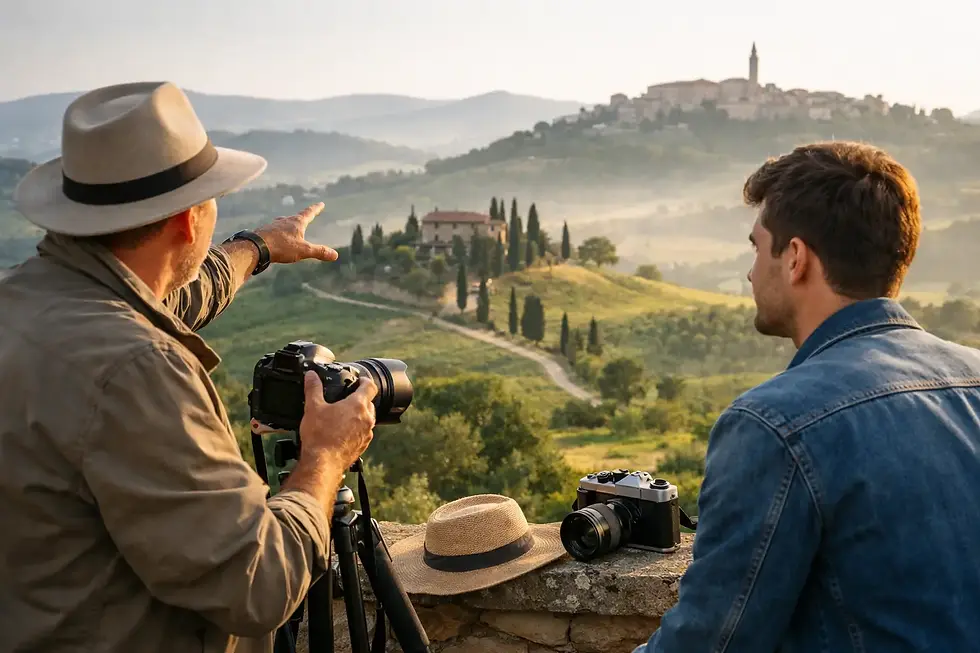
Workshop-based editing has a different advantage. When post-processing is tied directly to images made in the field, the learning becomes more coherent. You remember the changing weather, the dynamic range you faced, the reason you chose a certain lens, and the emotional intention behind the frame. That context makes editing instruction far more meaningful than working on random demo files.
This is where an immersive model can be especially effective. A photographer who spends sunrise with you on a mountain pass and then reviews the raw files later that day can explain not only how to edit the scene, but why certain adjustments bring it closer to what the location felt like. That continuity between capture and processing is difficult to replicate in a generic class.
The editing skills that matter most
If your goal is stronger landscape work, a course should help you build control in a few essential areas. Exposure blending matters, but not every dramatic sky needs a complex composite. Masking is important, but good masks are in service of light and shape, not complexity for its own sake. Color grading can elevate an image, yet it only works when the underlying tonal structure is sound.
What tends to matter most is learning to simplify. Many promising images fall apart because every area is edited with equal intensity. The foreground, sky, and distant layers all compete. A mature workflow teaches emphasis. Where should the eye rest first? Which tones need separation, and which should stay quiet? What needs detail, and what benefits from softness?
Dodging and burning are central here, especially for photographers moving toward fine art landscape work. Done well, they guide attention with subtlety. Done poorly, they leave obvious halos and a strained look. The difference usually comes down to patience and seeing the image as a whole rather than as a collection of isolated corrections.
What serious photographers often get wrong
Many experienced hobbyists assume their editing problem is technical, when in fact it is interpretive. They know the software well enough. What they need is a clearer sense of visual hierarchy and mood. Others focus too much on rescuing weak captures. Editing can refine and elevate, but it cannot fully replace better light, stronger composition, or cleaner field technique.
There is also a common tendency to chase style before developing sensitivity. Cinematic colors, dramatic contrast, and glowing highlights can be appealing, but they only work when they fit the place. A moody storm over the sea invites different treatment than spring light over vineyard hills. Good editing respects subject matter.
Another mistake is learning in fragments. One tutorial covers luminosity masks, another explains color calibration, another promises a fast fine art look. Useful pieces, yes, but without a guided framework they often produce confusion. A well-designed course organizes the process from file selection through final output so each step supports the next.
The value of learning editing in remarkable places
There is a reason destination workshops can change a photographer's trajectory. When you are working in locations with strong visual character - alpine ridgelines, quiet lakes, old stone villages, salt-sprayed coastlines - editing decisions become less abstract. You are not just correcting a file. You are translating the atmosphere of a place that affected you.
That emotional connection matters. It pushes you to ask better questions of your work. Did the image retain the calm of dawn? Did the edits preserve the scale of the mountains? Did the color treatment support the scene's natural mood or overpower it? These are artistic questions, and they are easier to engage when the shooting experience itself was intentional and well guided.
For that reason, many photographers benefit most from a learning environment that combines field instruction, review, and editing mentorship. Italy Photography Workshops follows that approach because it reflects how strong landscape images are actually made - not in isolated pieces, but through a continuous process of seeing, capturing, evaluating, and refining.
The right course should leave you with more than cleaner files. It should change the way you see your own photographs before you even begin to edit them.


Comments