


Why Small Group Photo Tours Work Better
At sunrise in the Dolomites, ten minutes can change everything. The light reaches one ridge, mist lifts from the trees, and a scene that looked flat in the dark suddenly becomes layered, delicate, and alive. In that moment, small group photo tours prove their value. You are not waiting for a large bus to unload or trying to hear instructions over a crowd. You are already in position, talking through composition, exposure, and timing with a photographer who can actually work with you one to one.
For serious enthusiasts and developing professionals, that difference is not minor. It shapes the images you bring home, the confidence you build in the field, and the level of artistic progress you make during the trip. A photography tour should do more than move you through beautiful places. It should sharpen your eye, challenge your habits, and help you understand why a scene works.
What small group photo tours do differently
The first advantage is simple: access. With a small group, it is easier to reach locations at the right hour, adjust plans for weather, and spend more time where conditions are strongest. In places like Venice, Cinque Terre, or Provence, that flexibility matters. A narrow alley, a quiet canal edge, or a cliffside turnout may work beautifully for six photographers and become clumsy with twenty.
The second advantage is instructional depth. Many photographers have taken trips where the destination was memorable but the learning felt thin. A guide points out a scene, everyone sets up tripods in a line, and the result is a set of near-identical frames. Small group photo tours create room for conversation. One participant may need help simplifying a foreground. Another may be working on long exposure technique. Someone else may be ready to discuss tonal separation, lens choice, or how to push a composition toward a fine art interpretation. That kind of teaching is only possible when group size stays intentionally limited.
There is also a practical side to small numbers that experienced travelers appreciate quickly. Loading gear takes less time. Moving between locations is smoother. Meals, timing, and daily pace feel more human. The workshop becomes immersive rather than crowded.
Better learning in the field
Photography improves fastest when feedback happens at the moment of decision. It is one thing to review a file later and realize the horizon should have been lower or the shutter speed should have been slower. It is another to catch that choice while the light is still changing and adjust in real time.
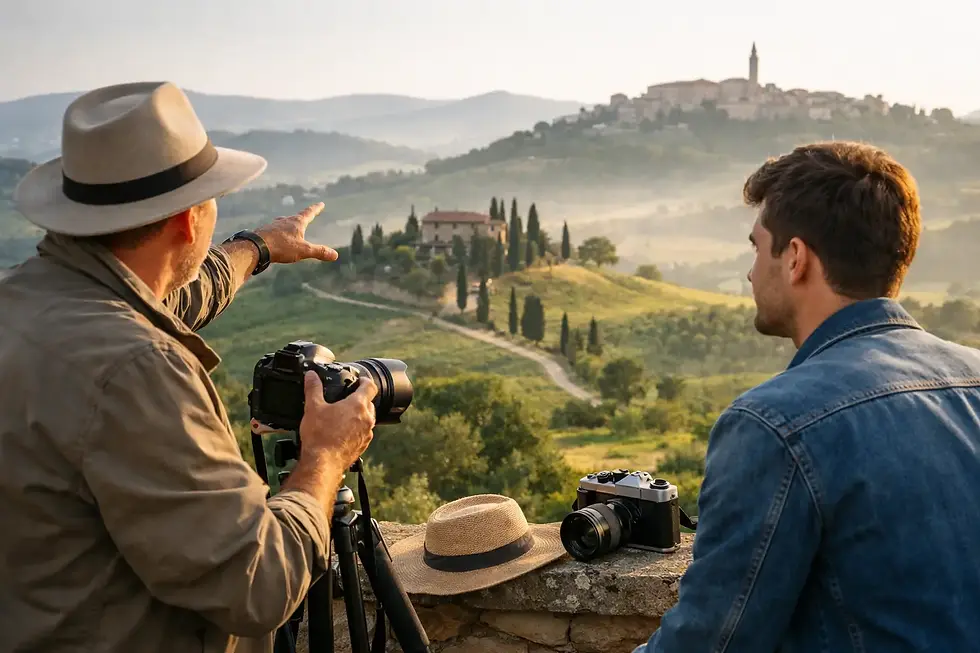
That is where a smaller format becomes especially valuable. In the field, instruction can stay specific. You can ask whether a 24mm frame feels too open, whether the brighter cloud is pulling attention away from the subject, or whether a vertical composition would create more tension. You can experiment, review, refine, and shoot again while the scene is still alive.
This matters across genres. In landscape photography, it helps you respond to shifting weather and complex light. In city photography, it helps you anticipate timing, movement, and visual rhythm. In coastal or mountain environments, it helps you balance creativity with efficiency, especially when the best conditions last only a short time.
A well-led tour should not feel like a race to collect viewpoints. It should feel like guided practice in extraordinary places.
Why small group photo tours lead to stronger images
Stronger images rarely come from standing in the right spot alone. They come from a sequence of better choices. You notice the direction of light. You exclude what weakens the frame. You wait for atmosphere. You decide whether drama needs contrast or restraint. You understand when the scene wants precision and when it wants mood.
Small group photo tours support that process because they allow for discussion, observation, and revision instead of quick capture. You are not just shown where to stand. You are coached through seeing.
That distinction becomes even more important for photographers trying to move beyond technically competent files. Many people know how to expose correctly and use quality equipment. Fewer know how to create images with depth, emotion, and a clear visual point of view. Real progress often comes from subtle refinements: controlling edge distractions, organizing layers in mist, using negative space in architecture, or choosing a shutter speed that supports the mood rather than simply freezing detail.
Those are not generic travel tips. They are the building blocks of stronger photographic work.
The value of local knowledge
Destinations such as Tuscany, Lake Como, Venice, or the Langhe are widely photographed, but local knowledge still changes the experience. The obvious viewpoint is not always the best one. The famous location may work only under certain weather patterns, seasons, or tides. A lesser-known hillside, harbor edge, or alpine approach may produce more distinctive results at the right hour.
That is one reason experienced photographers seek out tours led by someone who knows both the region and the craft. Local familiarity is not just about logistics. It affects timing, angle, atmosphere, and expectation. It helps answer the questions that matter most: When does this place actually come alive? Which season gives the most structure in the landscape? Where can we work well if the forecast turns? When should we stay longer rather than move on?
For visiting photographers, that guidance removes guesswork. It also reduces a common frustration: arriving at a beautiful place and still feeling unsure what to do with it.
Small groups make critique and editing more useful
A photography trip should not end when the memory cards are full. Some of the most meaningful growth happens later, when the field experience is translated into selection, refinement, and processing.
In a smaller workshop setting, image review becomes far more personal and far more honest. Instead of broad comments to the room, you can look closely at your own files and discuss what is working, what feels unresolved, and how editing choices support the intention of the image. That might mean improving tonal balance in a moody forest scene, controlling color in warm evening light, or making a black-and-white city image feel deliberate instead of simply desaturated.
This stage is often where photographers begin to recognize patterns in their own work. Maybe your compositions are strong but your edits are too heavy. Maybe you respond well to atmospheric scenes but rush when the light gets dramatic. Maybe your frames improve when you simplify aggressively. These insights are hard to reach in large, fast-moving tour formats.
Who benefits most from this format
Small group photo tours are especially effective for photographers who want more than a scenic vacation with a camera. They suit people who are serious about learning, open to feedback, and interested in making better images rather than just collecting locations.
That does not mean you need to be advanced. In fact, mixed experience levels can work well when the group is small and the instruction is adaptable. A strong workshop leader can help one participant understand filters and focal length while helping another refine sequencing, printability, or a personal visual style. The key is not uniform skill level. The key is a shared commitment to photographing with intention.
For many travelers, this format also feels more rewarding on a human level. Conversations are better. The pace is calmer. There is room for individual attention without losing the energy of a shared experience. You are part of a group, but not lost inside one.
Choosing the right small group photography experience
Not every small-group trip offers the same depth. Some are travel-first with light photographic support. Others are highly instructional and built around fieldwork, critique, and editing. Neither approach is wrong, but they serve different goals.
If your priority is artistic growth, look closely at how the days are structured. Are sunrise and sunset sessions central to the itinerary? Is there time to revisit locations when conditions improve? Does the workshop include image review or post-processing guidance? Is the leader teaching actively in the field, or mainly guiding the route?
This is also where the personality and experience of the instructor matter. The best workshops feel personally guided, not standardized. They combine strong destination knowledge with the ability to teach clearly, adapt to conditions, and meet photographers where they are. That is the standard we believe in at Italy Photography Workshops, because exceptional places deserve more than a checklist approach.
The right tour leaves you with more than a gallery of beautiful files. It changes how you work when the light turns difficult, when a scene feels chaotic, or when you sense an image is close but not finished. That kind of progress tends to happen in small groups, where time, trust, and attention are all on your side.
If you are going to travel for photography, choose a format that gives you space to learn as deeply as you shoot.


Comments