


Fine Art Photography Workshops That Elevate
You can stand in front of a perfect Alpine ridge at sunrise or a silent Venetian canal in blue hour and still come home with photographs that feel ordinary. That gap between a beautiful place and a meaningful image is exactly why fine art photography workshops matter. They are not just about access to dramatic scenery. They are about learning how to interpret a place, shape light, simplify composition, and turn a technically correct frame into something personal.
For many photographers, that transition is the hardest part of growth. Exposure can be learned. Sharpness can be checked. But mood, visual restraint, and intention usually need guidance, repetition, and honest feedback. A strong workshop gives you all three in the field, not months later when the moment is gone.
What fine art photography workshops should actually teach
The phrase gets used loosely, and that creates confusion. Some trips are really photo tours with light instruction. Others are technical boot camps focused on settings and gear. Fine art photography workshops should go further. They should teach you how to see with more purpose.
That usually begins with observation. Instead of chasing landmarks, you learn to study shape, atmosphere, depth, balance, and the emotional effect of weather and time of day. In the Dolomites, for example, the lesson might not be how to photograph a famous peak. It might be how side light reveals structure, how a low cloud layer simplifies the background, or why a longer focal length can create a more distilled image than a wide dramatic view.
The strongest workshops also connect capture with interpretation. If your field decisions do not support your editing approach, the final image often feels disjointed. A fine art process is more coherent. You expose with intent, compose with restraint, and process in a way that supports the feeling you recognized on location.
Why location matters in fine art photography workshops
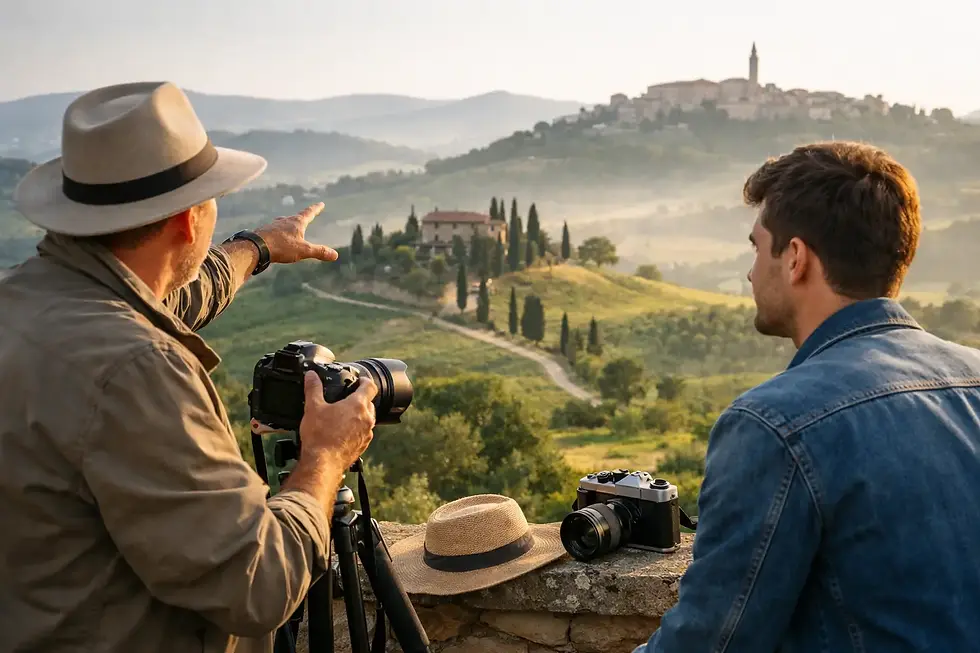
Not every destination teaches the same lessons. That is one reason generic workshop models often fall short. Fine art photography depends heavily on atmosphere, rhythm, and the relationship between subject and place. A photographer working in Tuscany’s rolling geometry is solving a different visual problem than one photographing the graphic layers of Venice or the jagged vertical drama of the Dolomites.
This is where local guidance becomes more valuable than many photographers expect. It is not only about getting to the right overlook. It is about knowing when mist usually settles in a valley, which canals hold clean reflections before foot traffic begins, or how a coastal scene behaves with a rising tide and moving cloud cover. Those details shape the image before you ever lift the camera.
Well-planned workshops also account for seasonality. A location that is strong in early autumn may be flat in summer. Spring may offer softer color transitions in one region and chaotic foliage in another. Good instruction includes these trade-offs because fine art photography is often less about quantity of shooting and more about timing, atmosphere, and selectivity.
The value of a small-group or private format
If your goal is artistic development, size matters. In larger groups, instruction often becomes reactive. The guide manages logistics, everyone lines up for the same composition, and feedback stays broad because time is limited. That can still be enjoyable, but it rarely produces the level of personal growth most serious photographers are looking for.
A small-group or one-to-one format changes the pace completely. You have room to ask why a composition is not working. You can test alternative framings instead of rushing through the scene. The instructor can identify patterns in your work, whether that is overcomplicating foregrounds, relying too heavily on wide lenses, or avoiding difficult light when that is exactly where stronger images live.
This kind of attention is especially useful for photographers who feel stuck between competence and expression. They know how to use the camera, but their portfolio lacks cohesion. In a more intimate workshop setting, critique becomes specific enough to change your habits.
What a serious workshop day looks like
The best workshop structure is immersive without becoming mechanical. A typical day often begins before sunrise, when the landscape is quiet and the light has subtle transitions that reward patience. Morning field sessions focus on seeing and shooting, not collecting as many frames as possible.
Later in the day, there is often a shift from capture to analysis. This might include reviewing what you made in the morning, discussing why one image carries more visual weight than another, or planning the next session based on weather, season, and your creative goals. Evening editing sessions can be just as important as time in the field because they teach you how to finish an image with discipline.
That final part matters more than many photographers admit. Editing is where promising files often become heavy-handed, over-textured, or emotionally confused. Fine art processing should not be a collection of effects. It should reinforce the structure, light, and mood already present in the raw image.
How workshops help you develop a personal style
Style is often misunderstood. It is not a preset, a color palette, or a dramatic sky applied to every scene. Personal style emerges when your choices become consistent - what you include, what you exclude, how you handle contrast, how much complexity you allow, and what kind of atmosphere you are drawn to.
A good workshop does not try to make everyone shoot like the instructor. It gives you a framework for making more intentional decisions. That might mean recognizing that you respond best to quieter scenes with layered depth, or that your strongest work comes from compressing space rather than exaggerating it. Once those tendencies are identified, they can be refined instead of left to chance.
This is where critique becomes one of the most valuable parts of the experience. Not every image deserves to be processed. Not every strong location produces a strong photograph. Hearing that clearly, and hearing why, helps you edit your work more honestly.
Choosing the right fine art photography workshop for you
A workshop can be beautifully marketed and still be the wrong fit. The key is to look past the destination and examine the teaching model. Ask whether the experience is built around instruction or simply around access. Ask how much time is spent in critique and post-processing. Ask whether the itinerary allows flexibility for weather and light.
You should also consider your own stage of development. If you are still building confidence with exposure and focus technique, you want an instructor who can teach fundamentals without reducing everything to basics. If you are more advanced, you need mentorship that addresses sequencing, editing consistency, and artistic intent.
There is also the question of pace. Some photographers thrive on moving through multiple regions in one trip. Others produce better work when they stay longer in fewer locations and return under changing conditions. Neither approach is universally better. It depends on whether your priority is visual variety or deeper interpretation.
For photographers traveling to Europe specifically, the best experiences tend to combine destination knowledge with serious education. That is where a specialist operator such as Italy Photography Workshops can stand apart - not just by leading you to iconic places, but by shaping the days around light, atmosphere, field instruction, and image review in a way that supports actual artistic growth.
What you should expect to leave with
The real outcome of a workshop is not a full memory card. It is a clearer photographic voice. Ideally, you return with a smaller set of stronger images, a better understanding of why they work, and a more disciplined process for creating the next ones.
You should also leave with practical gains: more confidence in difficult light, better judgment when building a composition, and a more refined approach to editing. Those improvements are transferable. They stay with you whether you are photographing mountain ridges, coastal villages, urban architecture, or your own local landscape back home.
That is the difference between a trip that feels exciting and one that changes your photography. The destination may first catch your attention, but the real value lies in being guided to see more deeply, work more deliberately, and create images that feel like your own. Choose a workshop that respects that process, and the places you photograph will start giving you more than views. They will start giving you real work.


Comments