


Discover the Soul of Piedmont: My Exclusive Barolo Photo Workshop in the Langhe Hills
- Paolo De Faveri
- Apr 19
- 6 min read
Updated: Apr 21
Hi, I’m Paolo De Faveri, professional landscape photographer and owner of Photo Workshops Italy. For about twenty years I’ve been guiding photographers through Italy’s most inspiring locations, but there’s one place that never fails to steal my heart — and my camera’s attention. It’s right here, just about 45 minutes from where I live: the rolling Langhe hills and the legendary Barolo vineyards of Piedmont. If you’re looking for a truly intimate, creative Barolo photo workshop that goes far beyond the usual “grand vista” shots, this is it.
Why the Langhe Hills Are a Photographer’s Dream
Most people think of Italy’s iconic landscapes as the jagged Dolomites or the colourful cliffs of Cinque Terre. I love those places too — but the countryside around Barolo and the Langhe hills offers something deeper. Here, beauty hides in the details: the rhythmic patterns of vineyards climbing the slopes of La Morra, the lonely farmhouses dotting the Po Valley, the ancient trees framing the Po River banks, and the dramatic silhouette of Serralunga Castle at sunset. Framing a compelling composition in these seemingly “ordinary” rural scenes is exactly what sharpens your eye and elevates your photography. As I always tell my students: “The countryside is the ideal playground for photographers who want to spark their creativity and bring their vision to another level.” And because I know every tree, stone, and blade of grass in these hills, I can take you straight to the spots where the light, mist, and mood come together perfectly.
The landscape here is visually generous, but it is also subtle. You are not overwhelmed by dramatic peaks or famous monuments at every turn. Instead, you work with repeating vineyard lines, isolated chapels, textured farmhouses, soft haze, cypress-like vertical accents, and villages perched on ridges with long views in every direction. The result is a destination that teaches you how to see.
Why the Langhe works so well for photographers
The hills of Langhe are not just beautiful - they are structured. That matters. Vineyards create rhythm and geometry across the slopes, and the road network opens up a surprising number of elevated viewpoints. Even within a relatively compact area, the terrain changes enough to keep compositions fresh. One ridge gives you layered agricultural patterns. The next offers a village skyline rising from mist. A third may frame a chapel against rolling hills under storm light.
This variety makes the area especially rewarding for photographers who want more than postcard views. You can work on composition with leading lines, visual balance, and foreground placement. You can study how atmosphere changes depth. You can practice simplifying a scene when the landscape is busy, or building complexity when fog and light add separation.
The Langhe also rewards repeat visits to the same location. A scene that feels modest in flat light can become exceptional at sunrise, after rain, or during a late autumn fog event. That is one reason guided photography in this area is so effective. Success often depends less on finding a famous spot and more on knowing when a specific ridge, road bend, or overlook is likely to come alive.
What makes a Langhe Hills photography tour different
A standard sightseeing trip through wine country usually follows food, wine, and village stops. A photography-focused experience works differently. The schedule is built around light first, then weather, then creative goals. That often means early starts, flexible midday plans, and returning to locations when conditions improve.
On a well-designed Langhe Hills photography tour, the educational value is just as important as the destination itself. The point is not only to come home with beautiful files. It is to understand why one angle works better than another, why a longer lens may simplify the vineyard patterns, or why a higher viewpoint might flatten the hills in a way that strengthens the image.
For serious enthusiasts and advanced amateurs, this matters. Many photographers can expose correctly. Fewer know how to turn a pleasant landscape into a compelling photograph. In the Langhe, that transition often happens through small decisions: shifting left to separate a bell tower from the background ridge, waiting five minutes for fog to open a gap, or choosing a vertical frame to emphasize the slope structure.
Best seasons for a Langhe Hills photography tour
Autumn is the season most photographers ask about first, and for good reason. Vineyard colors begin to warm, harvesting activity adds life to the landscape, and cool mornings can produce fog in the valleys. This combination creates atmosphere and depth that are difficult to fake in processing. Autumn also suits photographers who enjoy quieter color transitions rather than peak foliage drama.
Spring has different strengths. The vineyards are fresh, the hills are green, and the weather can shift quickly enough to produce expressive skies. If your style leans toward clean color, layered countryside views, and softer seasonal contrast, spring is excellent.
Summer can work, but it requires more discipline with timing. Midday light is often harsh, and heat shimmer can reduce clarity in distant layers. Early morning and late evening become even more important. The trade-off is longer days and a fuller sense of rural life.
Winter is less obvious, but for some photographers it can be the most poetic season of all. Bare vines reveal the underlying lines of the terrain. Villages feel quieter. Fog can become the main subject. The color palette is more restrained, which often leads to more refined, minimalist images.
The images most photographers come for
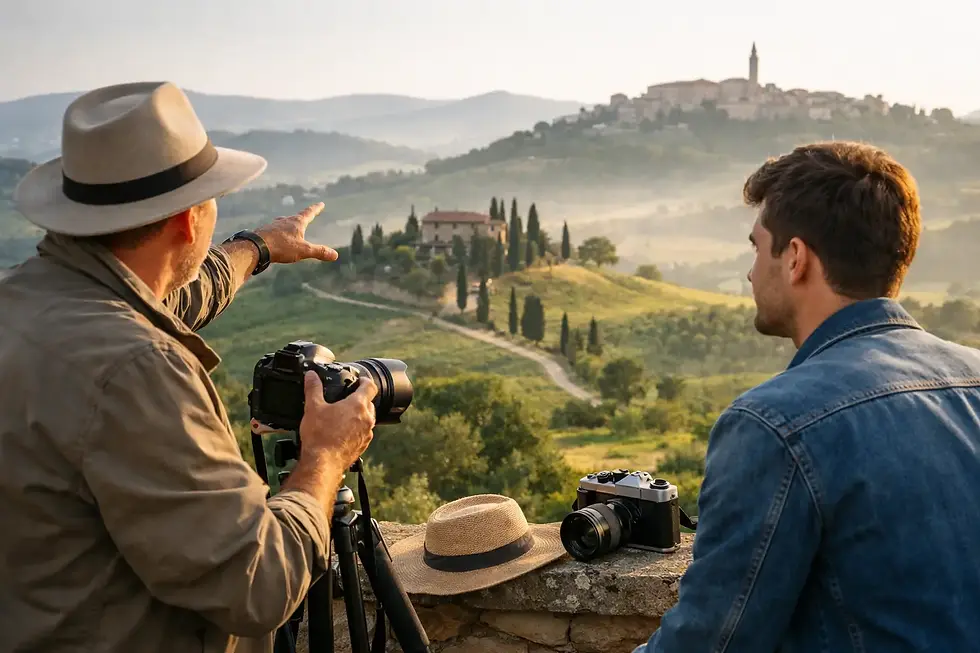
The classic Langhe frame is a layered telephoto landscape at dawn, with a hilltop village emerging above fog and vineyards stepping away into the distance. It is a beautiful image, but it is only one part of what the area offers.
Wide landscapes are strong here when the foreground is carefully handled. Vine rows, curved roads, and field textures can anchor the frame, but they need order. Without that, wide scenes become busy very quickly. Longer focal lengths are often even more useful. They compress the ridges, simplify the patchwork, and isolate structures like towers, farmhouses, and chapels.
Details matter too. Vineyard posts in low sidelight, weathered cellar doors, geometric slopes after rain, and village stone textures can all support a more complete photographic story. If you enjoy building a destination portfolio rather than collecting one hero shot after another, the Langhe is ideal.
Field instruction that actually improves your work
This is where the right workshop format changes the experience. The Langhe is full of roads and viewpoints, but access to strong photography is not just about driving around. It is about being in the right place under the right conditions and understanding how to respond when those conditions shift.
In practical terms, field instruction in the Langhe often focuses on reading weather, selecting focal length with intent, refining edge control, and working through composition options without rushing. It also helps to have direct feedback in real time. Many photographers stay too wide, include too much, or stop searching once they have a competent frame. A guided approach pushes past that first acceptable image.
That is especially valuable for photographers trying to develop a more mature visual style. The difference between a travel photo and a portfolio-worthy landscape image usually comes down to subtle choices. A mentor can see those choices immediately and help you make them while the light is still working.
For travelers who want a highly personalized experience, Italy Photography Workshops approaches destinations like the Langhe as both a location and a classroom. That combination is what turns a scenic trip into meaningful photographic progress.
Post-processing matters in the Langhe
The Langhe often produces files with delicate contrast, layered haze, and nuanced color. Those are strengths, but they also require restraint in editing. Overprocessed skies, excessive dehaze, and aggressive saturation can flatten the atmosphere that made the scene special in the first place.
A good workshop in this region should include some attention to editing decisions, because the finished image depends on preserving mood. Fog needs separation without losing softness. Vineyard greens or autumn golds should feel believable. Local contrast can help define the ridges, but too much can make the land look brittle.
This is one of the most overlooked parts of destination photography education. Strong fieldwork gets you the raw material. Thoughtful processing helps you keep the place recognizable while shaping the image toward your own artistic voice.
Who this destination suits best
The Langhe is an excellent choice for photographers who enjoy landscape work with atmosphere, pattern, and structure rather than extreme drama. If you love the challenge of making nuanced scenes powerful, you will likely connect with it deeply.
It is also ideal for travelers who value a slower, more intentional rhythm. The area lends itself to sunrise sessions, selective daytime scouting, evening light, and image review in between. If you need nonstop action, another destination may suit you better. If you want to refine how you see and compose, the Langhe gives you room to do exactly that.
You do not need to be an expert, but some patience helps. Conditions here can change quietly. The best image of the day may come from waiting for mist to thin, returning to a village overlook, or recognizing that a simple telephoto composition says more than a dramatic wide shot.
The Langhe does not force photographs on you. It rewards observation, timing, and intention. That is precisely why it stays with photographers long after the trip ends. If you are looking for a place that sharpens both your technique and your eye, this is one of Italy's most satisfying landscapes to photograph.


Comments