


Why One to One Photography Tuition Works
You can spend years watching tutorials, reading camera manuals, and practicing on your own, yet still feel stuck when the light turns difficult or a scene refuses to come together. That is exactly where one to one photography tuition changes the pace of learning. Instead of trying to translate broad advice into your own work, you get direct guidance in real conditions, with every decision shaped around your goals, your camera, and the way you see.
For many photographers, the gap is not effort. It is feedback. You may know how to expose correctly and still struggle to build stronger compositions, work a location with intention, or edit your files into finished images with character. Personal tuition closes that gap quickly because the teaching is immediate, specific, and grounded in what you are actually photographing.
What one to one photography tuition really offers
The real value of one to one photography tuition is not simply private attention. It is relevant attention. In a group setting, instruction has to be shared across different experience levels, equipment setups, and creative priorities. In a one-to-one format, every part of the day can be adjusted.
If you need help understanding filters and long exposures on the coast, the session can stay there until it clicks. If your priority is city work at blue hour, the timing and locations can be chosen accordingly. If your files are technically sound but lack atmosphere, the conversation can shift from settings to visual storytelling, lens choice, framing, and how to work changing weather instead of fighting it.
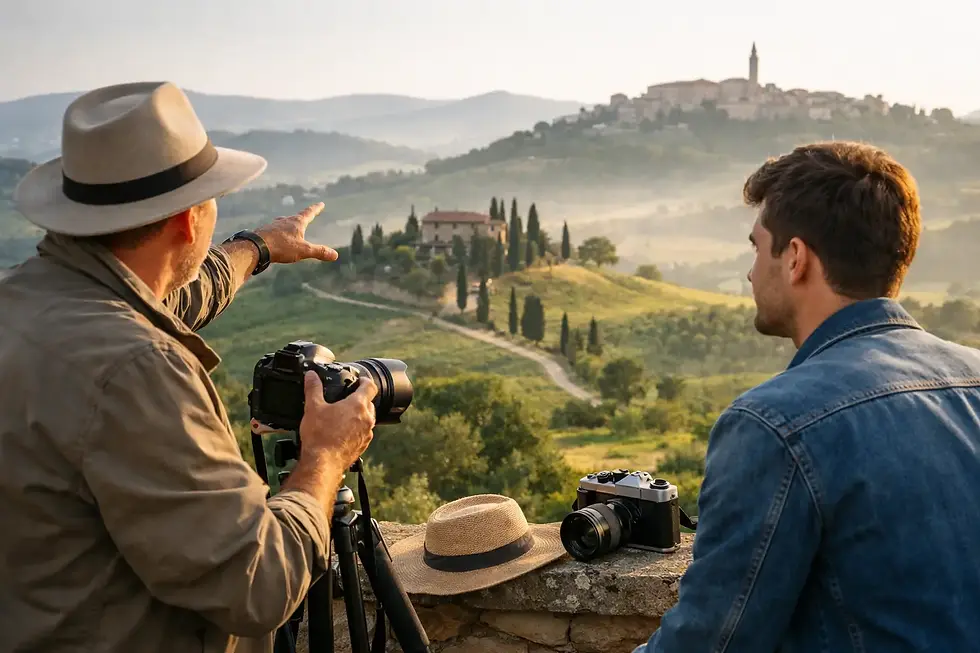
That flexibility matters even more in destination photography. Light in the Dolomites is not managed the same way as light in Venice. A quiet morning in Tuscany asks for a different pace than layered compositions on the cliffs of Cinque Terre or abstract details in Provence. Personalized tuition lets the day respond to the place, the season, and your level of experience.
Faster progress in the field
Photography improves when decisions become more deliberate. One of the strongest advantages of one to one photography tuition is that you are not learning in theory first and hoping to apply it later. You are making choices in the moment, with an experienced photographer helping you understand what to do and why.
That can mean small corrections with a big effect. Moving two feet to simplify a foreground. Waiting three minutes for a passing mist layer. Choosing a longer focal length to organize the background. Realizing that the problem is not your exposure, but the fact that the image has no visual anchor.
Those are hard lessons to teach in generic content because they depend on context. In person, they become obvious. You begin to understand not just camera settings, but scene selection, timing, patience, and restraint. That is where many photographers start moving from competent records of a place to images with mood and intent.
There is also a practical benefit. You waste less time. Instead of arriving at a famous location at the wrong hour, standing in a crowded viewpoint, and hoping for the best, you work with someone who already knows where the scene opens up, when the conditions are strongest, and how to adapt if the weather shifts. That local knowledge often matters as much as technical teaching.
Private tuition is not only for beginners
Some photographers hesitate because private instruction sounds like something reserved for those who have just bought their first camera. In reality, it often serves experienced photographers even better. Beginners usually need structure and confidence, but advanced amateurs and developing professionals need refinement. That kind of refinement is highly individual.
You may already understand exposure, focus modes, and editing software, yet still feel that your portfolio lacks consistency. Or perhaps you produce strong work at home but struggle when traveling because you do not know the terrain, the light patterns, or how to plan around narrow windows of opportunity. One-to-one teaching can address those exact weak points without spending hours on fundamentals you already know.
In many cases, the most valuable discussions happen beyond pure technique. Why does one frame feel calm while another feels cluttered? When does dramatic processing strengthen an image, and when does it bury the original mood? How do you build a set of images from a location instead of chasing isolated single shots? These are not beginner questions. They are the questions that shape artistic growth.
The best tuition combines shooting and review
A strong private workshop does not end when the camera goes back in the bag. Field instruction is only half of the learning process. The second half happens when you review the results carefully, identify patterns, and understand what the files are asking for in post-processing.
This is where many photographers make a leap. On location, you learn how to observe. During review, you learn how to judge your own work with more clarity. You begin to see recurring habits - horizon placement, edge distractions, over-processing, timid cropping, flat tonal control - and once those habits become visible, they become fixable.
Editing sessions are especially useful because they connect capture and outcome. You may realize that a better final image depends less on heavier software work and more on better decisions in the field. Or you may see the opposite: a file with strong structure that only needs careful tonal shaping and color discipline to fully come alive. Both lessons are valuable.
For photographers traveling to visually rich destinations, this combination of shooting and critique is often what makes the experience truly worthwhile. The location gives you opportunity. The guided review turns that opportunity into lasting progress.
Why destination matters in one-to-one learning
Private photography tuition becomes far more powerful when it is built around places that reward patience, observation, and timing. Italy is especially well suited to this style of learning because it offers such a wide range of visual problems to solve. Mountains, coastlines, historic cities, lakes, vineyards, and misty rural landscapes all ask different things from the photographer.
A sunrise session in the Dolomites might center on depth, scale, and changing alpine weather. Venice at dawn becomes an exercise in rhythm, reflection, and subtle light. Along Lake Como, you may work on balancing architecture with atmosphere. In Tuscany or the Langhe, the challenge often lies in simplification - finding structure in rolling terrain without overcomplicating the frame.
That variety is useful because it reveals where your instincts are strongest and where they need support. Some photographers are naturally drawn to grand scenes but struggle with intimate details. Others compose beautifully in cities but find open landscapes difficult to organize. A tailored itinerary can expose those patterns quickly and help correct them.
This is one reason Italy Photography Workshops appeals to serious travelers who want more than a standard photo tour. The combination of destination knowledge, flexible planning, field coaching, and image review creates a learning environment that feels personal from start to finish.
What to expect from a well-designed private workshop
The best private tuition is guided, but not rigid. You should expect structure, yet also room for adjustment as weather, energy, and creative momentum change. A good workshop begins with a clear understanding of your level, interests, and goals. From there, each session should serve a purpose.
One day may focus on composition and visual flow. Another may be dedicated to long exposures, forest atmosphere, or editing technique. The pace can be demanding if your goal is to maximize a short trip, but it should never feel generic. You are not there to follow a script. You are there to develop your eye.
You should also expect honest feedback. Not harsh for the sake of it, but precise enough to help. Good tuition does not flatter weak images or overwhelm you with jargon. It shows you what is working, what is not, and what to try next. Sometimes the answer is technical. Sometimes it is simply to slow down and stop shooting too soon.
The trade-off, of course, is that private tuition is a premium format. It costs more than joining a larger group workshop. But for photographers who value direct access, efficient learning, and a fully tailored experience, the return is often much greater. You are not paying for volume. You are paying for relevance.
Who benefits most from one-to-one instruction
The photographers who gain the most from one-to-one instruction are usually the ones who already care deeply about improvement. They do not want to collect random tips. They want to understand their own work more clearly and make stronger images on purpose.
That includes newer photographers who want a solid foundation, but it very often includes experienced enthusiasts who feel plateaued. If you are tired of guessing at locations, second-guessing your compositions, or coming home from remarkable places with files that do not match the experience, private tuition can be the reset that changes your trajectory.
The most rewarding part is that progress does not stay tied to one trip. Once you learn how to read light more carefully, simplify a frame, choose stronger timing, and edit with more control, you carry those habits into every future location.
A memorable destination can inspire you for a week. Personal guidance can reshape the way you photograph for years.


Comments