


Advanced Landscape Composition Workshop
You can stand in front of a perfect alpine sunrise, with clean light on the peaks and mist moving through the valley, and still come home with a forgettable frame. At an advanced landscape composition workshop, that gap becomes obvious very quickly. The challenge is no longer exposure or sharpness. It is learning why one image holds attention and another, made from the same overlook a few feet away, falls flat.
That is where serious photographers often get stuck. They know their camera well enough. They can use filters, bracket exposures, and focus stack when needed. What they want next is not another checklist. They want a more disciplined way of seeing, and they want it in places that reward patience, movement, and timing.
What an advanced landscape composition workshop should actually teach
A strong workshop at this level is not about repeating basic rules. It is about understanding relationships inside the frame. Foreground, midground, and background matter, but only if they work together with intent. Leading lines can help, but only when they guide the eye to something worth reaching. Symmetry can be powerful, but sometimes imbalance creates more tension and life.
This is why advanced composition training needs to happen in the field, not only in a classroom. Light shifts. Weather changes. Crowds appear. Water rises and falls. A mountain scene that looked promising at first light may become stronger ten minutes later when a shadow slides across the ridge and separates forms that were previously merged. You learn composition by reacting to real conditions and by understanding what to change when a scene is close, but not quite resolved.
The best instruction also goes beyond where to place the horizon. It addresses visual weight, edge control, shape repetition, negative space, color contrast, scale, and the emotional effect of lens choice. These are the decisions that move an image from competent to memorable.
Why advanced photographers benefit from guided critique
Many experienced photographers plateau because they self-correct only within their existing habits. They know what they like, but they do not always see what they repeat. One photographer consistently overfills the frame. Another depends too much on dramatic skies. Another makes technically excellent files without establishing a clear subject.
In an advanced landscape composition workshop, critique is where patterns become visible. A good instructor is not only pointing out what failed. He is helping you understand why you were drawn to a composition in the first place, what nearly worked, and what small adjustment would have made the image stronger.
That kind of feedback is especially valuable in destinations with complex visual layers. Venice, for example, can easily become cluttered if every line, reflection, and architectural element competes for attention. The Dolomites offer the opposite problem. The scale is so grand that photographers often make wide scenes that feel empty rather than expansive. Both locations demand compositional restraint, but in different ways.
Advanced landscape composition workshop locations matter
Not every beautiful destination is equally useful for teaching composition. Some places impress you immediately but offer limited variation. Others reveal more the longer you stay and the more carefully you work them.
That is why workshop design matters as much as scenery. A serious program should place you in locations that allow multiple approaches. Mountain passes with shifting weather teach layering and depth. Coastal cliffs and tidal inlets teach rhythm, balance, and timing. Historic towns at blue hour teach geometry, light control, and selective framing. A good itinerary does not just chase icons. It gives you situations where compositional decisions become unavoidable.
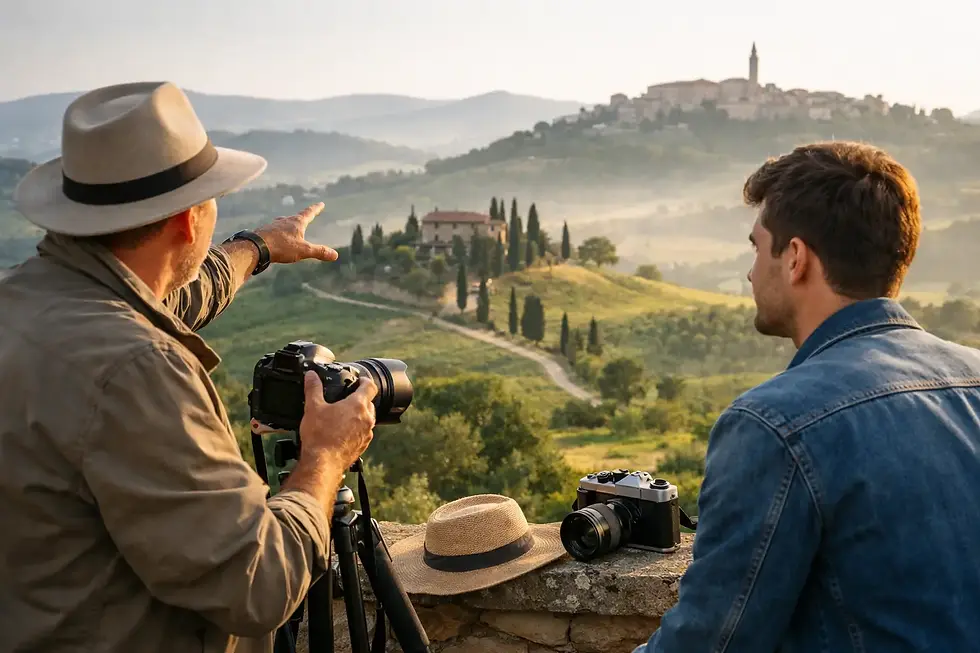
Italy is particularly strong for this kind of learning because the landscapes are visually rich without feeling generic. In the Dolomites, jagged peaks, rolling meadows, winding roads, and weather movement create endless structure. In Tuscany, the land is quieter, which forces you to work more carefully with shape, spacing, trees, and atmospheric depth. Along the coast, changing surf and layered rock formations create scenes that reward slow observation rather than fast shooting.
When those places are taught by someone who knows how conditions evolve through the day and across the seasons, the workshop becomes far more efficient. You spend less time guessing where to stand and more time refining what the frame needs.
What happens in the field
A strong day in an advanced workshop usually begins before sunrise, but the teaching starts before the tripod comes out. You discuss weather, direction of light, terrain, and likely visual problems. Is the foreground too dominant? Will the sky become a distraction? Is the subject better isolated with a longer lens, or does the scene need environmental context?
Once on location, the process is interactive. You may begin with an obvious composition, then be challenged to find three alternatives that change the image completely. One might emphasize line. Another might strip the scene down to tonal contrast and shape. A third might use compression to remove empty space and create a tighter emotional read.
This matters because advanced composition is not about finding the one correct frame. It is about learning to identify the strongest interpretation for the mood, light, and visual structure in front of you. Sometimes the grand wide shot is right. Sometimes it is weaker than a quiet telephoto crop on a band of light crossing a hillside.
That is also where one-to-one instruction can be transformative. In a personalized format, the instructor can respond to your instincts in real time. If you tend to build images from foreground interest, you can be pushed to simplify. If you gravitate toward minimal scenes, you can be challenged to organize complexity without losing clarity. Italy Photography Workshops has built much of its approach around that kind of direct field mentorship, which suits photographers who are ready for more than generic group commentary.
The role of editing in composition
Composition does not end when you press the shutter. At an advanced level, post-processing becomes part of how the image reads. This does not mean fixing weak framing later. It means understanding how local contrast, luminosity, color balance, and crop decisions reinforce the compositional intent that was already present in the field.
Evening review sessions are often where the day's lessons fully land. You notice that the image you were unsure about has the strongest internal structure. You see that a small crop removes a dead edge and suddenly the eye flows cleanly through the frame. You realize that reducing saturation can make shape and light more prominent, which was the true strength of the scene all along.
There is a trade-off here. Some photographers prefer to solve everything in camera, while others are comfortable refining more heavily in processing. Neither approach is automatically better. What matters is that editing supports the composition rather than substituting for it.
Who this kind of workshop is really for
An advanced workshop is best for photographers who already have technical control and are ready to question their defaults. If you can work comfortably in manual or aperture priority, read changing light, and use a tripod efficiently, you are likely ready. If your files are technically solid but your portfolio feels inconsistent in impact, you are probably exactly the kind of photographer who benefits most.
It is less about labels like advanced amateur or semi-professional and more about intent. The right participant wants to slow down, revisit scenes, accept critique, and work through variations instead of collecting locations. That mindset is often what separates a productive workshop from an expensive photo trip.
It also helps to be honest about your goals. Some photographers want stronger single images. Others want a more cohesive body of work. Some are preparing for print, exhibition, or client-facing portfolios. Those goals affect how composition is taught, because an image designed to stand alone may be built differently from one intended to sit within a broader series.
How to choose the right advanced landscape composition workshop
Look closely at group size, instructor involvement, destination knowledge, and whether image review is built into the experience. If the schedule is all movement and no reflection, the learning will likely stay shallow. If the instruction is too generic, advanced participants tend to hear concepts they already know without discovering what is actually limiting their work.
The most useful workshops are immersive enough to let ideas repeat in different conditions. A single dramatic sunrise can be exciting, but composition matures when you revisit the same standards across mountains, coastlines, villages, forests, and weather shifts. You begin to recognize your own tendencies. More importantly, you learn when to trust them and when to break them.
There is no shortcut for that. Better composition comes from a mix of guidance, repetition, and honest editing. A great place helps. So does beautiful light. But what changes your photography is learning to see structure before the scene disappears, then shaping it with intent while everything around you is still moving.
If that is the stage you are in, the right workshop does more than improve your next trip. It changes how you arrive at every scene after that.


This was such a insightful post on advanced landscape composition! You've really captured the nuances of how to approach these more complex scenes, and I particularly appreciated the section on breaking down intricate elements. It definitely gave me a fresh perspective; I'd always found myself a bit overwhelmed by busy vistas, but your breakdown makes it feel so much more manageable https://www.abs.gov.au/statistics/economy/finance/household-expenditure-survey/latest-release Honestly, I feel like my entire team could gain a lot from reading this. We've been struggling with creating depth in our recent projects, and your explanation of foreground, midground, and background interplay is spot on. It perfectly aligns with some of the challenges I've been facing on a personal project where I'm trying to depict a dense…
Really valuable content here https://en.wikipedia.org/wiki/Blog I was searching for information on this topic and your article answered many of my questions. Keep up the excellent work!
Really valuable content here read this article I was searching for information on this topic and your article answered many of my questions https://en.wikipedia.org/wiki/Blog Keep up the excellent work!