


Tuscany Photography Tour for Serious Shooters

The first light in Tuscany does not announce itself loudly. It arrives as a soft lift in the mist, a pale glow along cypress ridges, a warm edge touching stone farmhouses and vineyard lines. That quiet transition is exactly why a Tuscany photography tour works so well for photographers who want more than postcard views. The region rewards patience, timing, and local knowledge, and when those pieces come together, the landscape starts giving you photographs with atmosphere, depth, and character rather than just pretty scenery.
For many traveling photographers, Tuscany is familiar before they ever arrive. They have seen the winding roads, the lone villas, the geometric fields, and the hill towns bathed in evening light. What is less obvious from a distance is how selective Tuscany can be. The strongest images depend on season, weather, haze, crop cycles, and the angle of light across rolling terrain. A meaningful tour here is not simply about visiting famous spots. It is about knowing when a location is ready to be photographed and how to work it with intent.

What makes a Tuscany photography tour worth it
Tuscany is one of those destinations where access and timing matter just as much as technical skill. You can rent a car, drive through Val d'Orcia, and still miss the most photogenic moments by an hour or a week. Morning mist may settle in one valley and leave another flat. Fresh green fields might transform a composition in spring, while late autumn can bring structure, muted color, and cleaner light for a more refined fine art approach.
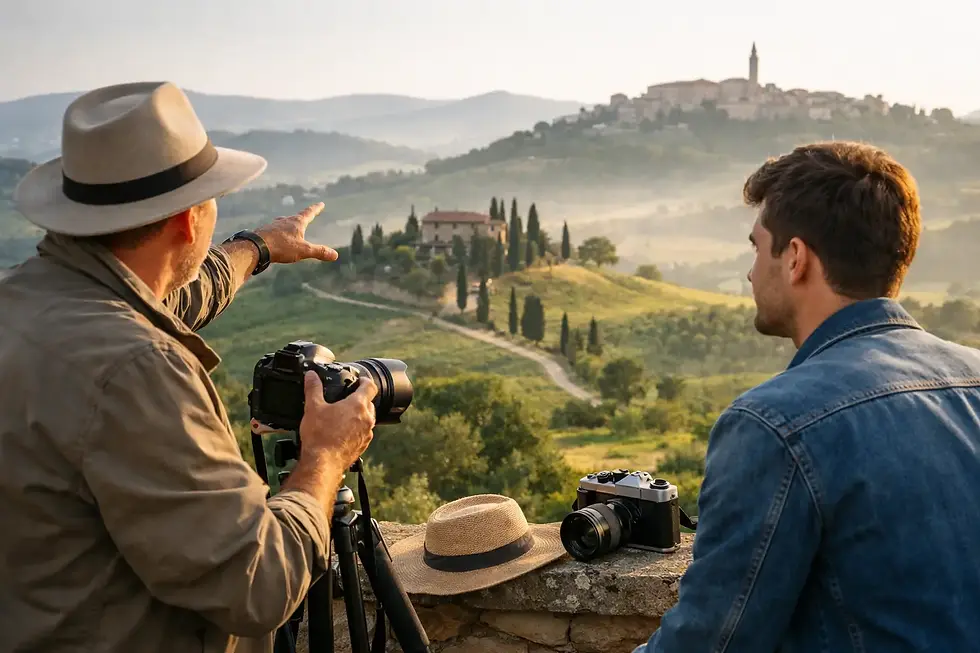
This is where a guided photography experience has real value. Instead of spending your energy guessing where to be at sunrise, you arrive prepared, in position, and ready to shoot. That changes the pace of the day. It creates room for better composition, more thoughtful lens choices, and practical teaching in the field.
A strong tour also solves a common problem for serious enthusiasts - getting beyond technically correct images. Many photographers come to Tuscany already knowing how to expose properly and use a tripod. What they often need is help simplifying a scene, reading layers in a landscape, controlling visual weight, and deciding whether an image should emphasize atmosphere, structure, or graphic rhythm. Tuscany is excellent for learning those decisions because the land is generous with shape but unforgiving of clutter.

The landscape lessons Tuscany teaches
Tuscany looks effortless in great photographs. It is not. Rolling hills can flatten quickly if the light is wrong. Foregrounds that seem promising with the eye can become distracting through the lens. The famous cypress roads and farmhouses are powerful subjects, but only when the surrounding land supports them.
On a well-designed Tuscany photography tour, the education is built directly into the landscape. Sunrise sessions often focus on layering, compression, and the use of changing fog to create separation. Midday may be better reserved for scouting, selective details, monochrome thinking, or image review. At sunset, the lesson often shifts toward balance - how to keep warm light from overpowering the frame and how to maintain clarity in a scene with multiple competing lines.
There is also a deeper creative lesson here. Tuscany invites restraint. You do not need to force drama into every image. Some of the strongest photographs from this region are quiet: a stand of trees in distant haze, the curve of plowed earth, a farmhouse held in negative space. For photographers trying to develop a more mature visual style, that is valuable territory.

Why season changes everything
Not every month produces the same Tuscany. Spring is often associated with fresh greens, gentle fog, and a sense of renewal in the land. It can be ideal for soft tonal work and classic pastoral scenes. Early summer can bring richer contrast and longer evenings, though some fields may become visually busier depending on agricultural cycles.
Autumn is especially attractive for photographers who prefer earthy palettes, lower sun angles, and a slightly quieter atmosphere. The air can feel clearer, the textures more pronounced, and the compositions more distilled. Winter has its own appeal as well, particularly for moody weather, bare structure, and fewer visitors, but it requires flexibility and a willingness to work with less predictable conditions.
The right season depends on the kind of portfolio you want to build. If your goal is iconic Tuscany with luminous greens and mist, one timing makes sense. If you are drawn to minimalism, storm light, or subdued color, another may serve you better.

How the best Tuscany photography tours are structured
The format matters as much as the destination. Photographers improve fastest when the tour is built around both shooting and reflection. That means early starts, yes, but also enough time to review images, discuss what worked, and refine the next session.
A premium tour in Tuscany typically works best over several days rather than a rushed two-stop itinerary. The region unfolds slowly. Weather can shift. Some locations reveal their best potential only after a first visit. Having time to revisit a scene with different light often produces stronger results than constantly chasing new viewpoints.
Small groups or private instruction are especially effective here. Tuscany is not a destination where ten photographers should be standing shoulder to shoulder on the same roadside turnout. Individual guidance makes a difference when adjusting composition by a few steps, choosing focal length based on terrain compression, or deciding whether to wait for fog to build or move on. This kind of mentorship is one reason photographers book with a specialist rather than a general travel operator.
Many of the most rewarding workshop formats also include evening critique and post-processing sessions. That is where field experience turns into understanding. You can examine why one frame has better visual flow than another, how subtle dodging and burning strengthens the eye path, or why a restrained color grade suits Tuscany better than heavy saturation. Italy Photography Workshops approaches this style of instruction in a way that connects location work with artistic development, which is exactly what serious travelers are usually seeking.

What you should expect to practice in the field
A Tuscany photography tour is not only about standing at viewpoints. It is a chance to work on specific photographic skills in a location that gives immediate feedback. Composition is at the center - especially simplification, line control, and the placement of isolated subjects within broad landscapes.
Lens choice becomes a major teaching point. Telephoto lenses are often more useful than visitors expect because they compress hills, isolate farms, and organize layers of light and atmosphere. Wide-angle lenses still have their place, but they demand stronger foreground discipline. Without that, the scene can feel empty rather than expansive.
Exposure technique matters too, particularly at dawn when mist and brightening sky create subtle tonal transitions. You may also work with bracketing when dynamic range increases, though not every scene needs it. The stronger habit is learning to recognize what the image is really about before reaching for a technical fix.
Then there is movement through the landscape. A productive tour teaches you when to stay still and when to keep searching. Some scenes improve by waiting for cloud breaks or drifting fog. Others become stronger only after changing elevation, shifting laterally, or abandoning the obvious composition for something quieter and more personal.

Choosing the right Tuscany photography tour for your goals
Not every photographer wants the same Tuscany. Some want an immersive fine art experience built around atmosphere, editing, and portfolio-quality output. Others want a broader travel experience with photography woven into it. Neither approach is wrong, but they lead to different results.
If growth is your main objective, look for a tour that emphasizes personalized instruction, flexible scheduling, and enough time in each location to work a scene properly. Ask whether the itinerary is adapted to weather and season. Ask whether critique and post-processing are part of the program. Ask how many participants are in the group. These details affect the quality of the experience far more than a packed list of famous stops.
It also helps to be honest about your current level. You do not need to be advanced to benefit from Tuscany, but you will get more from the trip if the instruction is matched to your needs. A developing photographer may need support with exposure, tripod technique, and visual organization. A more experienced shooter may need help editing a tighter series, refining tonal treatment, or moving from scenic documentation toward a more deliberate body of work.
That is the real promise of Tuscany when it is approached well. It is not just a beautiful place to visit with a camera. It is a landscape that can sharpen judgment, deepen visual sensitivity, and teach you to photograph with more intention. If you give it time, and if you work it with purpose, Tuscany has a way of slowing you down in the best possible sense. Often that is when your strongest images begin.


Comments