


Small Group Photography Tours Italy Guide
Some trips leave you with a full memory card and very little change in your photography. Others shift the way you see. That is the real appeal of small group photography tours Italy offers when they are built around mentoring rather than simple sightseeing.
Italy is one of those rare countries where light, history, texture, and atmosphere all work together. Alpine ridgelines catch first light in the Dolomites. Venetian canals turn reflective and quiet before the city wakes. Tuscany softens into layers of mist, cypress lines, and warm stone. On paper, any photographer can travel there alone. In practice, timing, access, local knowledge, and structured guidance make the difference between getting a record shot and making a photograph with depth.
Why small group photography tours Italy travelers choose work so well
A small group changes the rhythm of the entire experience. With fewer participants, you are not standing three rows back waiting for your turn at a viewpoint or trying to keep up with a generic itinerary built for mixed interests. The day can be shaped around light, weather, tides, seasonal color, and the pace photography actually requires.
That matters more in Italy than many travelers expect. Good photography here often happens at the edges of the day, in transitional weather, or in locations that reward patience. A narrow street in Venice may look ordinary at noon and extraordinary at blue hour. A Dolomite scene can go from flat to dramatic in ten minutes as cloud breaks over the peaks. In Tuscany, morning fog can create the kind of layered composition people travel across the world to photograph, but only if you are already in position before sunrise.
In a small group, there is also room for teaching. That sounds obvious, but many tours use the word workshop loosely. Real instruction means discussing lens choice before the shoot, helping you simplify a chaotic foreground, explaining why a composition is not yet working, and reviewing files afterward so the learning carries into the next day.
What serious photographers should expect from a well-run tour
The best tours are not just about being taken to beautiful places. They are designed around photographic outcomes. That means the instructor is thinking constantly about season, conditions, group ability, and how to help each participant grow.
A strong small-group workshop in Italy usually includes both field sessions and image review. In the field, the teaching is practical and immediate. You may work on exposure blending at sunrise, long exposures on the coast, or using architecture to control perspective in historic city centers. Later, during editing sessions or critiques, the conversation shifts from camera settings to visual intention - how to guide the eye, manage contrast, refine color, and create a more cohesive final image.
This balance is where many photographers improve fastest. Capturing the frame is only part of the process. Learning how to edit with restraint, protect mood, and develop a fine art sensibility is often what moves someone from competent travel images to work with a personal voice.
The best Italian regions for small group photography tours
Italy is not one photographic experience. It is several very different ones, and the right destination depends on what you want to practice.
The Dolomites for drama and changing mountain light
For landscape photographers, the Dolomites are one of Europe’s strongest workshop locations. The appeal is obvious - jagged peaks, alpine lakes, high meadows, and fast-changing weather. But they also reward technical discipline. You need to read shifting conditions, compose cleanly in complex terrain, and work quickly when the light opens up.
Small groups are especially valuable here because mountain photography often depends on flexibility. If cloud cover kills one plan, you need alternatives. If a location is overworked or the light is not cooperating, a good local photographer-guide knows when to change direction rather than force the shot.
Venice for atmosphere, layers, and visual restraint
Venice can overwhelm photographers who arrive without a plan. There is beauty everywhere, but there is also visual clutter, heavy foot traffic, and the temptation to make the same obvious picture everyone else makes. A workshop setting helps you slow down and work with intention.
The city is ideal for studying light on water, repetition, reflections, graphic composition, and mood. Early mornings are critical. So are quieter corners away from the busiest routes. In a small group, it becomes much easier to move through the city efficiently and work with subtle scenes that would be impossible with a larger tour bus mindset.
Tuscany for classic landscape structure
Tuscany is often seen as easy to photograph because it is so naturally beautiful. In reality, it is easy to photograph badly. The region asks for control - careful layering, elegant use of negative space, sensitivity to haze, and a disciplined eye for simplifying pastoral scenes.
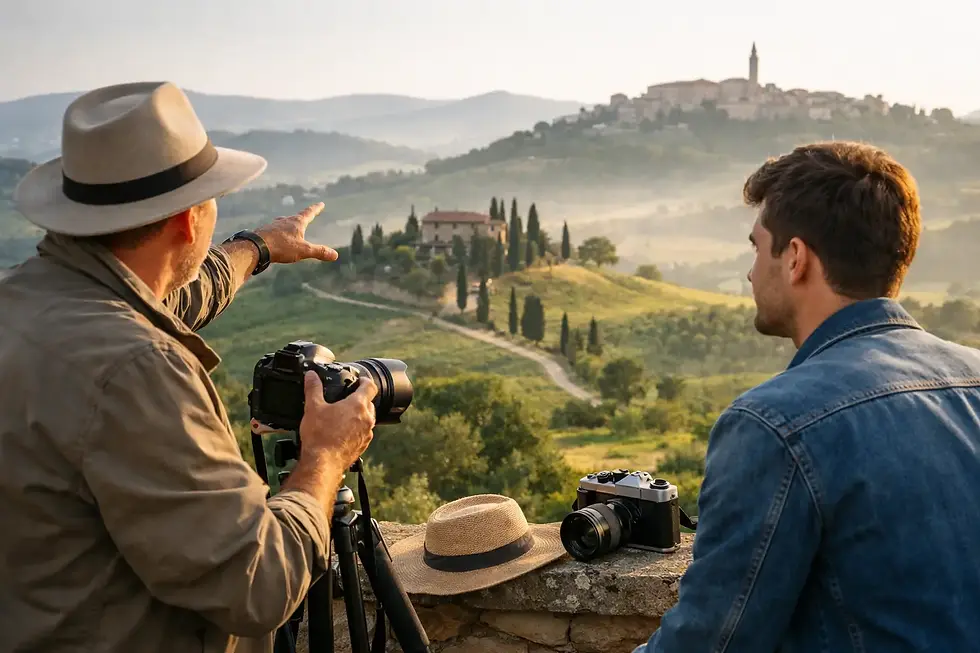
This is where mentorship matters. A scene of rolling hills can quickly become flat if the focal length is wrong or if the composition lacks rhythm. A guided small group gives you the chance to refine those choices on location, not later when the opportunity is gone.
Cinque Terre, Lake Como, and coastal regions for timing and mood
Italy’s coastal areas offer a different challenge. Villages, harbors, cliffs, and changing water conditions create strong opportunities for long exposure, twilight work, and balancing built environments with natural forms. Timing is everything. Tide, weather, and crowd levels all affect what is possible.
Here again, small groups have an edge. You can move faster, hold better shooting positions, and adapt when conditions shift. You are also more likely to reach lesser-known vantage points rather than cycling through the same postcard stops.
Who benefits most from small-group workshops
Not every photographer needs the same kind of trip. Some are still building confidence with manual exposure and composition. Others are technically solid but want to make more intentional, emotionally resonant work. Small-group formats serve both, provided the teaching is personalized.
If you are newer, the value is clarity. You stop guessing about where to stand, what lens to use, or how to expose a high-contrast scene. If you are more advanced, the value is refinement. You can work on nuance - visual hierarchy, editing consistency, and the difference between a strong capture and a finished image.
That individualized attention is one of the strongest reasons to choose a premium workshop over a standard photo tour. A small group gives the instructor space to respond to your habits, your blind spots, and your creative goals.
What to ask before booking small group photography tours Italy
Not all small groups are equally small, and not all tours with a camera-friendly itinerary are true workshops. Before booking, look closely at how the program is taught.
Ask how many participants are in the group. Ask whether the itinerary is flexible around weather and light. Ask whether there are editing sessions, critiques, or classroom components. Ask who is actually leading the trip and whether that person has photographed the destination deeply across seasons.
It is also worth asking how physically demanding the tour is. Italy can mean easy city walking, steep alpine terrain, or long pre-dawn departures depending on the region. The best experience is not the most ambitious itinerary on paper. It is the one that fits your energy, interests, and photographic goals well enough that you can stay focused on making images.
The learning advantage of traveling with a photographer-host
There is a meaningful difference between being guided by a tour manager and being guided by a working photographer who teaches in the field. The second option tends to be more responsive, more honest, and far more useful.
A photographer-host is not just moving people from one stop to another. He is watching the sky, reading the scene, thinking about how wind or fog may change the composition, and helping participants react creatively. He can explain why one foreground strengthens the image while another distracts from it. He can show how a subtle shift in camera height changes the relationship between forms. He can also tell you when a scene is simply not worth forcing.
That kind of direct mentorship is one reason photographers choose businesses like Italy Photography Workshops. The trip becomes more than access to beautiful locations. It becomes a concentrated period of artistic development in places that deserve more than a quick snapshot.
The right tour will leave you with strong images, of course. More importantly, it will leave you seeing light, structure, and atmosphere with greater intent long after Italy is behind you. When that happens, the trip continues to shape your photography every time you pick up the camera.


Comments