


Sardinia Photography Tour for Serious Shooters

The light changes fast on Sardinia’s coast. One minute the sea is a hard, reflective blue, and the next it softens into silver while granite headlands catch the last warm edge of sunset. That is exactly why a sardinia photography tour works so well for photographers who want more than pretty views. The island rewards timing, patience, local knowledge, and a clear shooting plan.
Sardinia is often talked about as a beach destination, but for photographers, that barely scratches the surface. It is a place of dramatic weather, sculpted rock formations, quiet inland villages, ancient architecture, and long stretches of coastline where mood matters as much as location. If your goal is to come home with a stronger body of work rather than a memory card full of similar frames, Sardinia has real depth.

Why a Sardinia photography tour stands out
What makes Sardinia different from many Mediterranean destinations is contrast. You can photograph luminous turquoise water and white sand in one session, then move to rugged cliffs, wind-shaped juniper trees, or dark stone towns in the next. The visual range is unusually broad, and that gives a skilled workshop leader room to build an itinerary around conditions rather than forcing the same shot every day.
For serious enthusiasts and advanced amateurs, that flexibility matters. A good tour is not just transport between viewpoints. It is a structured photographic experience shaped around light, weather, tides, and your personal goals. Some photographers arrive focused on long-exposure seascapes. Others want stronger composition, cleaner field technique, or help translating a dramatic landscape into a fine art image. Sardinia can support all of that, but only if the trip is designed with intention.
Another reason the island photographs so well is that it still offers space. Even in popular areas, there are times of day and less obvious viewpoints where the landscape feels open and unforced. That is invaluable if you are trying to slow down, refine composition, and work a scene properly instead of reacting to crowds.

What you can photograph in Sardinia
The coastline is the obvious draw, and for good reason. Sardinia’s shores offer granite formations, hidden coves, cliffs, sea stacks, harbors, and beaches with water so clear it can look almost surreal in direct sun. But the challenge is making that beauty photograph well. Midday can be harsh, especially in summer, and a good workshop approach teaches you when to avoid obvious scenes, when to use stronger light graphically, and when to return at dawn or dusk for shape, separation, and atmosphere.
Beyond the coast, Sardinia has a quieter visual character that often surprises visitors. Inland areas can feel raw and timeless, with pastoral landscapes, textured hills, and villages where the architecture carries a completely different rhythm from the shoreline. These locations are useful for photographers who want to broaden a portfolio and avoid a one-note trip.
There is also excellent potential for detail work. Weathered doors, stone walls, fishing boats, old streets, and local textures can become powerful studies in color, repetition, and surface. Not every strong image in Sardinia needs an epic horizon. In fact, some of the most memorable frames come from narrowing your attention.

The best season depends on what you want to shoot
There is no single perfect time for a Sardinia photography tour. It depends on your tolerance for heat, your preferred subjects, and the kind of atmosphere you want in your images.
Spring is often the most balanced season. The temperatures are more comfortable, the landscape can carry fresh color, and the light is generally kinder for long field sessions. It is an ideal time for photographers who want to combine seascapes, villages, and broader landscape work without fighting peak-season intensity.
Autumn is another strong choice, especially for those who prefer calmer conditions and a less crowded feel. The sea remains visually attractive, but the pace shifts. That can be helpful if your process is more deliberate and you value time for review, reshooting, and evening editing sessions.
Summer has obvious appeal because the island is at its most vivid, but it comes with trade-offs. The light can be severe in the middle of the day, popular coastal areas may be busier, and scheduling becomes more important. Summer can still work very well if the itinerary is built around early starts, late finishes, midday scouting, and selective indoor critique or post-processing time.
Winter is less conventional, but for photographers drawn to mood, empty spaces, and storm-driven coastlines, it can be rewarding. The palette changes, the atmosphere deepens, and the island shows a more austere side. It is not the season for everyone, but for some photographers it produces the most distinctive work.

What good photographic instruction adds
A beautiful destination alone does not improve your photography. Instruction does. That is where the difference between a general tour and a photography-focused experience becomes clear.
In the field, the most valuable guidance is often not technical in the narrow sense. Yes, shutter speed, filtration, focal length choice, and exposure control matter. But many photographers plateau because they can operate the camera without fully understanding visual structure. They know how to expose a scene, yet the image still feels flat. On location in Sardinia, that often comes down to spacing between elements, edge control, the relationship between foreground and horizon, and whether the light is actually serving the composition.
This is why one-to-one feedback is so important. Two photographers can stand in the same place and need entirely different advice. One may need help simplifying the frame. Another may need encouragement to move closer, work longer, or embrace more ambiguity in changing light. A serious workshop should meet you where you are rather than pushing a fixed formula.
Evening review sessions can be just as important as the shoot itself. Sardinia offers strong raw material, but turning that material into finished images requires judgment. Editing is where many photographers either overwork the drama or underplay the subtlety. A guided workflow helps you retain the character of the place while making thoughtful choices around contrast, color, texture, and tonal balance.

How a Sardinia photography tour is typically structured
The best format is usually multi-day and intentionally paced. Sardinia is not a place to rush. Distances, changing conditions, and the variety of subjects all favor an itinerary with enough time to return to locations under different light and to adapt when weather shifts.
A strong program usually centers on sunrise and sunset sessions, with the middle of the day used selectively. That time might be spent scouting, resting, photographing interiors or village details, or working on post-processing and critique. This rhythm keeps the focus on quality rather than exhaustion.
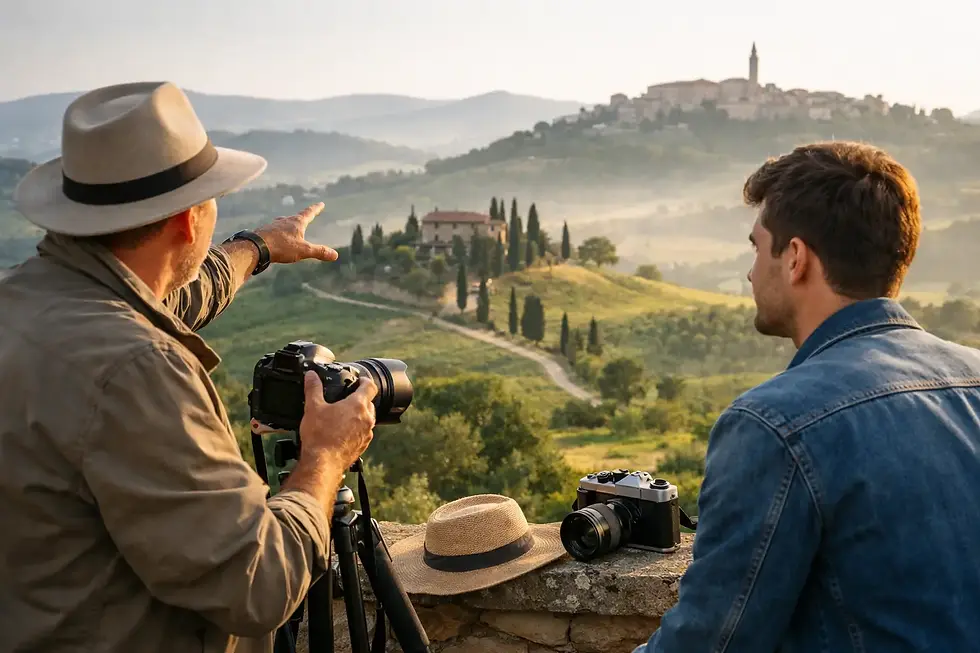
Small groups are especially well suited to Sardinia. They allow quick adjustments, easier access to less obvious spots, and more meaningful instruction in the field. For photographers who want the highest level of personalization, a private workshop is often the most productive option. It allows the itinerary to be built around your pace, skill level, and creative priorities, whether that means long-exposure coastal work, fine art landscape development, or a broader destination portfolio.
Italy Photography Workshops approaches trips in exactly that spirit - as guided photographic experiences shaped around conditions, individual goals, and the process of making stronger images, not simply visiting famous places.

Who benefits most from this kind of trip
A Sardinia workshop is especially valuable for photographers who feel technically capable but creatively inconsistent. If you occasionally make images you love but cannot do it reliably, the combination of location access, live feedback, and structured editing can be transformative.
It is also a strong fit for travelers who want depth instead of volume. Sardinia is not best experienced as a checklist. It rewards those who are willing to revisit a cove at first light, wait for clouds to reorganize a sky, or spend an hour refining a composition among rocks and surf.
That said, the island is not only for advanced photographers. Enthusiastic intermediate shooters often grow quickly here because the scenes are rich enough to teach composition clearly. The key is having guidance that keeps the experience focused and manageable.

What to expect from the images you bring home
If the tour is well designed, you should come home with more than scenic postcards. You should have a more coherent set of images and a clearer understanding of why they work. Some frames may be dramatic. Others may be quiet and understated. Both have value.
Sardinia gives you room to build a portfolio with range - seascapes, fine art landscapes, village scenes, abstract coastal details, and environmental storytelling. That variety is part of its appeal. It pushes you to respond to changing subjects while maintaining a consistent photographic voice.
The real value of a Sardinia photography tour is not only the island itself, remarkable as it is. It is the chance to photograph a place with enough beauty, complexity, and quiet challenge to move your work forward. If you give it time, attention, and expert guidance, Sardinia tends to give something back.


Comments