


Provence Photography Workshop Guide
Updated: Apr 23

The first time you stand in a Provence lavender field at blue hour, the scene feels almost too orderly to be real - repeating rows, soft haze, maybe a stone village on the horizon, and light changing by the minute. That is exactly why a Provence photography workshop matters. Provence is generous, but it is not easy. The region rewards photographers who know when to arrive, where to stand, how to simplify a busy frame, and when to leave the obvious shot behind.
For photographers who want more than a scenic trip, Provence offers an unusually rich mix of subjects. You can work graphic compositions in the lavender plateau around Valensole, intimate landscape studies among olive groves and cypress lines, architectural frames in hilltop villages, and atmospheric street scenes in local markets. Within a single workshop, it is possible to move from wide-angle landscape work at sunrise to telephoto abstracts in the afternoon and finish with editing sessions that turn strong captures into finished photographs.
Why a Provence photography workshop works so well
Some destinations are beautiful but repetitive. Provence is not. Its visual range is one of the main reasons photographers return. The famous lavender fields are only one part of the story. The region also gives you Romanesque abbeys, ochre earth, vineyards, sunflower fields in season, pale stone farmhouses, and villages that catch the last side light beautifully.
What makes the experience especially valuable in a workshop setting is the pace of change. Light can go from flat to extraordinary in twenty minutes. Fields that seem ordinary at midday become layered and luminous at sunrise. A guided approach helps you respond with purpose rather than simply react. Instead of chasing postcard views, you begin to understand why one angle carries depth, why one lens creates order while another creates clutter, and why weather can be an advantage rather than a disappointment.
This is also a region where local knowledge saves time. Access roads, bloom timing, traffic, field orientation, and village activity all shape the shooting day. A workshop led by a photographer who knows the area can make the difference between arriving with the wrong light and being in position before the scene comes alive.

What you actually learn in a Provence photography workshop
A strong workshop should do more than place you in front of beautiful scenery. It should teach you how to work the location. In Provence, that often starts with composition. Lavender rows can create powerful leading lines, but they can also overpower the frame and flatten the image if handled without care. You learn to control spacing, align geometry, and choose a focal length that supports the structure of the scene.
Light is the second major lesson. Provence rewards patience and timing. Early morning often brings softer contrast and cleaner color, while evening light can add warmth and dimension to villages, stone walls, and vineyards. Midday is less useful for broad landscapes, but it can be excellent for detail studies, interior scenes, shaded market photography, or black and white work with stronger contrast. That trade-off matters. A well-designed workshop does not pretend every hour is ideal for every subject.
Technique follows naturally from the setting. Depending on conditions, you may work with focus stacking for foreground-to-background sharpness, exposure bracketing in high-contrast scenes, tripod discipline at dawn, and handheld methods in villages where speed matters more than perfect stillness. For photographers moving toward fine art landscape work, Provence is also an ideal place to refine visual editing - deciding what stays in the frame, what gets excluded, and how to move from descriptive images toward photographs with mood and intention.
Post-processing is part of that growth. The palette of Provence can be subtle or intense, and both approaches can fail if pushed too hard. Lavender, warm stone, dry grasses, and soft skies need restraint. Editing sessions help photographers preserve atmosphere, control saturation, shape tonal contrast, and keep the final image believable while still expressive.

Best seasons for a Provence photography workshop
Most photographers first think of lavender, and for good reason. Late June through mid-July is typically the key window, though bloom timing varies with altitude, weather, and the specific area. Valensole often becomes the center of attention during this period, but it is not the only option. Quieter areas can be more productive if the goal is not simply to see lavender, but to photograph it well.
Spring and early summer are excellent for a broader workshop experience. Fields are active, villages feel alive, and the landscape has freshness without the peak-season pressure of the main lavender rush. If you prefer a more varied portfolio, this can be a better balance than a workshop focused only on purple fields.
Autumn has its own appeal. Vineyards shift in color, tourist traffic eases, and the quality of light often becomes gentler. You lose the iconic lavender look, but you gain a slower rhythm and more room to work carefully. For some photographers, especially those interested in atmosphere, architecture, and agricultural textures, fall is the stronger choice.

Locations that shape the experience
Valensole is the name most photographers know, and it deserves its reputation. The open plateau gives broad agricultural geometry, long sightlines, and classic sunrise opportunities. It can also be crowded and visually messy in the wrong conditions. The best results usually come from shooting beyond the obvious roadside stops and working compositions with discipline.
Gordes, Roussillon, and nearby Luberon villages bring a different side of Provence. Here the emphasis shifts toward stone texture, layered rooftops, narrow lanes, and elegant combinations of architecture and landscape. These locations are especially useful for photographers who want to improve framing, visual balance, and the relationship between built form and environment.
Abbaye de Senanque is another major draw when lavender is in bloom, but it is also a place where expectations need managing. It is iconic, yes, but often busy. A good workshop approach is to treat it as one part of a broader visual story rather than the entire goal.
Smaller villages and lesser-known rural roads often produce the strongest photographs. They may not be famous, but they allow more freedom, fewer distractions, and compositions that feel personal rather than borrowed.

Who benefits most from this kind of workshop
A Provence photography workshop is particularly valuable for photographers who are technically comfortable but want stronger artistic consistency. Many serious hobbyists can expose correctly and use their gear well, yet still come home with images that feel generic. Provence exposes that gap quickly. The scenery is beautiful enough to flatter weak habits, but structured instruction helps you move beyond surface beauty.
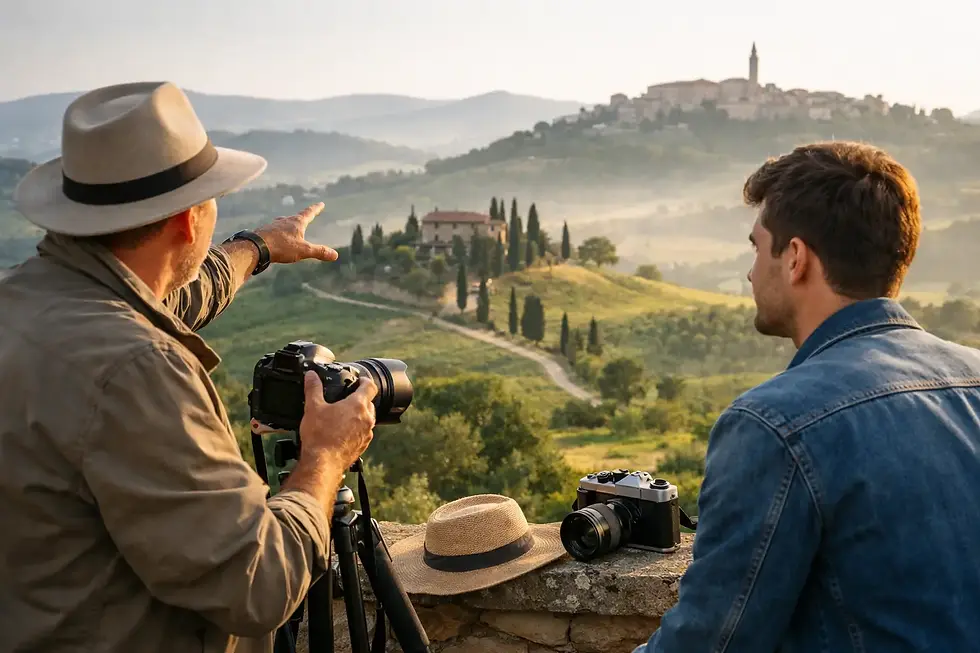
It also suits photographers who want direct mentorship rather than a large tour format. Small-group or private instruction gives space for real feedback in the field - not just where to stand, but why a composition is working, what lens choice is doing to the scene, and how to adapt when weather changes. That kind of teaching is difficult to replicate in a large bus-based trip.
For advanced amateurs and developing professionals, the region is excellent for portfolio building. You can create a body of work with range, coherence, and a distinct sense of place. That matters if your goal is not simply to travel with a camera, but to grow as an image-maker.

What to expect from the workshop rhythm
The best workshops in Provence are built around light, not convenience. That usually means early starts, a mid-day break or editing session, and evening shoots that stretch into twilight. It is a rewarding rhythm, but it helps to arrive prepared for it. The most productive days are rarely the easiest ones.
Expect a mix of field instruction and image review. In the field, the teaching should be practical and immediate - composition, settings, timing, perspective, and creative choices. Later, review sessions help connect those decisions to the finished image. That is where progress often becomes clear.
A premium, instructor-led format also brings flexibility. If weather shifts, if bloom is late in one area, or if a quieter village is producing better conditions than a famous spot, the itinerary can adapt. That flexibility is one of the real advantages of a personalized approach, and it is central to how Italy Photography Workshops designs destination-based photographic experiences.
Bring your preferred camera system, a sturdy tripod, wide and short telephoto options, and the willingness to slow down. Provence is not only about seeing more. It is about seeing better.
The photographers who leave with the strongest work are usually not the ones chasing the most locations. They are the ones who learn to read the light, simplify the frame, and return to the same scene with more intention than they had an hour before. Provence rewards that kind of attention, and that is why it remains such a compelling place to learn.


Comments