


Fine Art Travel Photography That Feels Personal
You can stand in front of the same Venetian canal, the same Tuscan hillside, or the same Dolomite ridgeline as a hundred other photographers and still come away with something unmistakably your own. That is the real promise of fine art travel photography. It is not about collecting landmarks. It is about translating a place through your sensibility, your timing, and your choices in the field and in post-processing.
Many photographers arrive at this genre after a familiar frustration. Their files are technically sound, exposure is under control, and the destination is extraordinary, yet the images still feel descriptive rather than expressive. They show where you were, but not what you felt. Fine art travel work begins when documentation stops being the goal.
What fine art travel photography really asks of you
At its best, fine art travel photography sits in the space between observation and interpretation. You are still responding to a real location, real light, and real weather, but you are not obligated to render the scene literally. You are shaping mood, editing complexity, and deciding what deserves emphasis.
That shift changes everything. Instead of asking, “How do I photograph this place?” you begin asking, “What is this place saying today, and how can I express it clearly?” On a misty morning in the Langhe, that may mean reducing a landscape to layers and tonal subtlety. In Venice, it may mean isolating gesture, reflection, or repetition rather than chasing the postcard view. Along the coast in Cinque Terre, it may mean waiting until the last trace of direct color leaves the sky so the village sits in a quieter, more contemplative palette.
This is why strong travel fine art work often feels less busy than standard travel imagery. It is selective. It leaves things out. It accepts that a beautiful place does not automatically make a strong photograph.
Fine art travel photography starts before the shutter
Most photographers think of fine art as something that happens in editing, but the more important decisions happen earlier. Vision starts with intent. Before you set up a tripod or choose a lens, you need to know what kind of image you are trying to make.
Sometimes that intent is emotional. You may want a mountain scene to feel solitary rather than grand, or a city scene to feel atmospheric rather than energetic. Sometimes it is formal. You may be drawn to geometry, compression, negative space, or monochrome tonality. The location matters, but your visual priorities matter more.
This is also where local knowledge becomes invaluable. Fine art images often depend on conditions that are short-lived and highly specific - low fog in a vineyard valley, reflected side light on a limestone facade, high tide in a canal, fresh snow softening structure in an alpine village. If you only arrive at the obvious viewpoint at the obvious time, you are more likely to make the obvious frame.
A guided workshop can shorten that learning curve dramatically because it combines logistics with artistic direction. You spend less energy guessing where to be and more energy refining how to see.
Composition: less spectacle, more clarity
In travel photography, it is easy to confuse visual richness with visual strength. Historic cities, dramatic coastlines, and mountain landscapes offer endless detail, but detail alone does not create impact. Fine art composition is often an exercise in restraint.
That may mean simplifying the frame until only the essential relationships remain. A lone cypress against rolling fog. A facade and its shadow. A receding row of mooring poles in winter haze. Strong compositions tend to have a clear center of gravity, even when they feel quiet.
Lens choice plays a major role here. Wide angles can be effective, especially when foreground structure supports the image, but they can also exaggerate clutter and weaken emotional focus. A short telephoto often helps compress forms and isolate what matters. In mountain environments, it can turn chaotic terrain into elegant layers. In cities, it can strip away distraction and make rhythm visible.
There is no rule that says fine art must be minimal, of course. Some scenes gain power from complexity. The difference is whether the complexity feels organized. The viewer should sense intention, not accumulation.
Light and weather are not just technical variables
Photographers often speak about good light as if it were a universal condition. It is not. Fine art travel photography depends on matching light to mood.
Soft fog can turn a familiar landscape into something lyrical. Hard side light can emphasize age, texture, and architecture. Rain can quiet a city and create reflection, while overcast conditions can be ideal for color harmony in pastel villages or forest interiors. Even flat light has a place when the subject is about shape, repetition, or subtle tonal control.
The trade-off is that expressive conditions are not always convenient. They may require early starts, multiple returns, or the patience to stay in a location longer than planned. This is one reason serious photographers benefit from itineraries built around photography rather than sightseeing. The schedule has to bend to weather, season, and creative opportunity.
Editing is where style becomes visible
Post-processing matters in every genre, but in fine art travel photography it becomes part of authorship. Not because the image should look artificial, but because editing determines how clearly your interpretation comes through.
Start with tonal structure. Ask yourself where you want the viewer to rest and where you want the eye to move quickly. Contrast should support that path, not simply make the file more dramatic. Color requires the same discipline. A location may offer rich hues, but that does not mean all of them belong at full strength. Muted color often carries more emotional sophistication than saturation pushed for effect.
Black and white can be powerful, especially in cities, mist, and winter conditions, but it should solve a visual problem or strengthen the concept. It should not be a rescue strategy for weak color. The same goes for texture, glow, split toning, and other stylistic choices. They can be effective when they reinforce the feeling of the image. They become distracting when they are applied by habit.
The photographers who grow fastest are usually the ones willing to review their edits critically. Evening critique sessions after a day in the field are so useful for exactly this reason. You begin to see patterns in your work - where you over-process, where you hedge, where you fail to commit, and where your strongest instincts are already emerging.
Why destination matters, but not in the way most people think
Iconic destinations matter because they offer atmosphere, history, and visual depth. Italy and southern France are full of places where light, architecture, landscape, and season create exceptional photographic possibilities. But the destination itself is only the raw material.
What matters more is whether the place supports the kind of work you want to make. If you are drawn to tonal subtlety and quiet layers, autumn vineyards and winter lagoons may suit you better than peak-season coastlines. If you thrive on structure and gesture, old cities reward repeated walks at different hours rather than one rushed circuit. If you are pursuing painterly landscapes, weather transitions may be more valuable than blue-sky forecasts.
This is where personalization becomes more than a luxury. It becomes a creative advantage. A photographer working on atmospheric city studies should not be shooting the same schedule as someone focused on classic grand landscapes. The strongest workshop experiences account for that difference and adapt in real time.
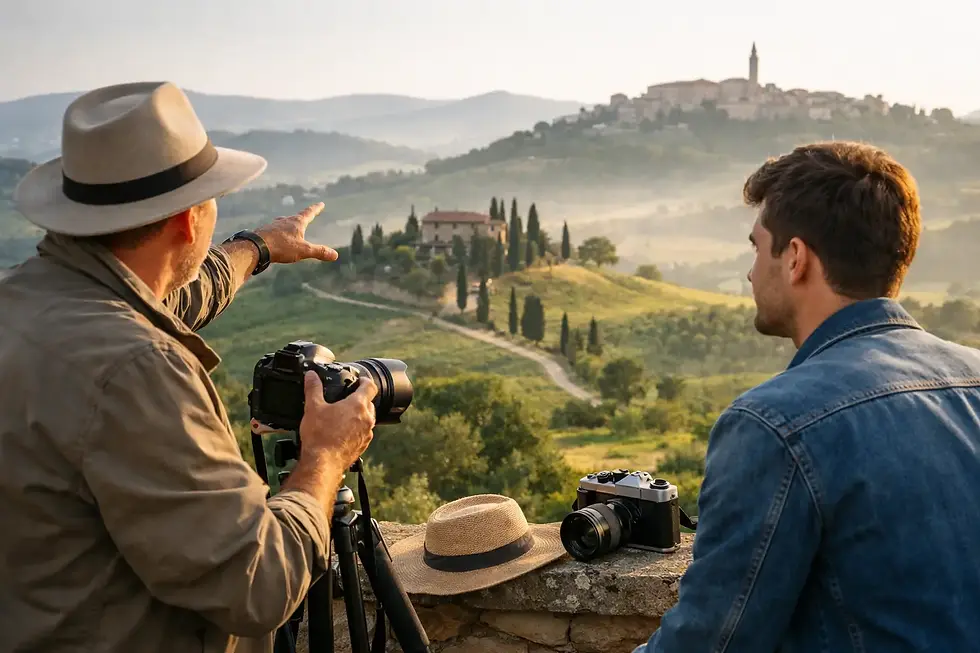
With Italy Photography Workshops, that instructor-led flexibility is part of the appeal. You are not simply driven to viewpoints. You are coached through why a scene is working, when it is not, and how to adjust your approach so the final image feels intentional.
How to grow in fine art travel photography faster
The biggest leap usually comes from slowing down. Stay longer at fewer locations. Revisit strong scenes in changing conditions. Review your files with honesty. Ask what the image is about, not just whether it is sharp.
It also helps to build projects instead of chasing singles. A body of work from Venice in fog, a study of alpine solitude, or a series on coastal villages at blue hour will teach you more than a mixed folder of unrelated highlights. Series force consistency. They reveal your preferences, and they expose your shortcuts.
Most of all, accept that this genre is not solved by gear or presets. It develops through experience, editing discipline, and the willingness to move beyond visual tourism. The camera records a place. The photographer gives it meaning.
The next time you arrive somewhere extraordinary, resist the urge to prove you were there. Make the quieter, harder picture instead - the one that feels less obvious, more resolved, and more like your own way of seeing.


Comments