


12 Best Places for Landscape Photography
The best places for landscape photography are not always the biggest names on a map. They are the places where light has room to move, where weather adds character, and where a photographer can return to the same scene in different conditions and keep finding new images. That is why truly memorable landscape work comes from locations that offer both visual drama and creative depth.
For photographers who travel with intention, the question is not simply where to go. It is where the landscape gives you options at sunrise and sunset, in clear weather and mist, with wide lenses and longer focal lengths, from iconic viewpoints and quieter angles. The strongest destinations reward patience, technical control, and a willingness to work a scene rather than collect snapshots.
What makes the best places for landscape photography
A great landscape destination usually combines three things: strong natural design, reliable shooting opportunities, and enough variety to support different styles of image-making. Grand mountains can be spectacular, but if the light is often flat or access is difficult at the right time of day, the experience can be frustrating. A less famous coastline may be more productive because it offers tide movement, textured foregrounds, and changing weather that creates atmosphere.
For most serious photographers, variety matters as much as beauty. You want a location that can give you intimate details, layered compositions, and broad scenic views within a manageable distance. That flexibility is especially valuable on a workshop or photo tour, where the goal is not only to visit beautiful places but to build a stronger portfolio and develop your way of seeing.
12 best places for landscape photography
The Dolomites, Italy
The Dolomites are among the finest mountain landscapes in Europe for photographers who care about shape, structure, and changing alpine light. Jagged peaks catch first and last light with remarkable clarity, and the region offers everything from reflective lakes to rolling pastures and dramatic high passes.
What makes the Dolomites especially rewarding is how many visual languages exist in one area. You can work wide scenes at sunrise, isolate graphic ridgelines with a telephoto lens in the afternoon, and photograph moody forests or weather-driven layers when the peaks disappear into cloud. Autumn is exceptional for color contrast, while early summer brings green meadows and cleaner access to higher locations.
Tuscany, Italy
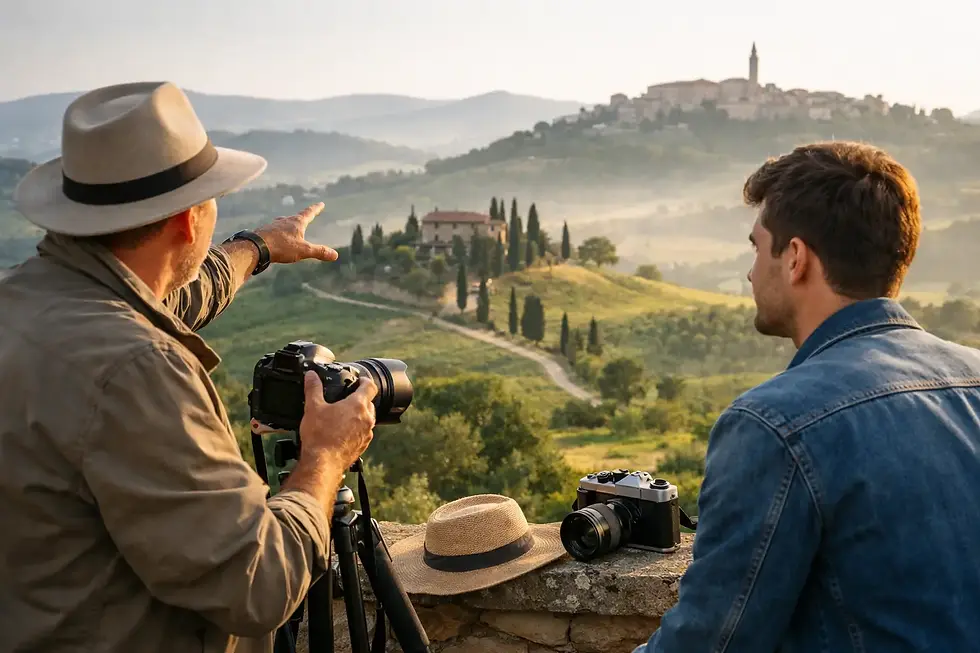
Tuscany is often underestimated by photographers who think only in terms of epic mountains. Its strength is not raw scale but rhythm. Fields, cypress lines, farmhouses, vineyards, and distant hills create naturally ordered compositions that are ideal for learning balance, depth, and tonal control.
Fog can be as valuable here as sun. In the right season, morning mist simplifies the scene and turns familiar countryside into something more refined and poetic. Tuscany is also one of the best places to train your eye for subtlety. The light is rarely about shock value. It is about restraint, shape, and timing.
Cinque Terre, Italy
Cinque Terre offers a different kind of landscape challenge, where coastal scenery meets human presence. The villages, cliffs, terraced hillsides, and sea create layered compositions that change dramatically with angle and elevation. At dawn, the quieter atmosphere allows for more controlled shooting, while evening often brings warmer side light and visible life in the villages.
This is a strong destination for photographers who want to bridge classic landscape and fine art travel imagery. The trade-off is that access and crowds require planning. If you arrive at the wrong time and shoot only the most obvious overlooks, your images may feel familiar. If you work the edges of the villages and pay attention to weather, the place becomes far more nuanced.
Venice Lagoon, Italy
Venice is not usually the first answer people give when discussing landscape locations, but the lagoon is one of the most atmospheric environments in Europe. Water, mist, distant architecture, tidal movement, and minimal horizon lines create opportunities for quieter, more interpretive work.
The lagoon teaches patience. Some mornings give you almost nothing except pale tones and stillness. Then a subtle shift in fog reveals layers of poles, islands, and reflections that produce images with real mood. For photographers interested in simplicity and atmosphere rather than visual excess, this is an extraordinary place to work.
Lake Como, Italy
Lake Como gives you a sophisticated blend of water, mountain backdrop, elegant architecture, and shifting weather. The lake can feel polished in clear conditions, but it becomes much more interesting when clouds move through and break the light across the slopes.
It is a destination with strong compositional range. You can frame broad lake views, isolate villages on distant shorelines, or use gardens, stone walls, and boats as foreground structure. The challenge is avoiding postcard repetition. The answer is to treat the lake as a system of layers and transitions rather than a single scenic view.
Sardinia, Italy
Sardinia is one of the most versatile Mediterranean locations for photographers who love the coast. Granite formations, turquoise water, remote coves, wind-shaped vegetation, and cleaner horizons make it especially productive for long exposures and seascape work.
Different areas of the island have very different visual personalities. Some shorelines are graphic and minimal, others rugged and textured. That variation makes Sardinia a strong choice for photographers who want more than one style of coastal image in a single trip. Shoulder seasons are often best, when the light is gentler and access is easier.
Langhe, Italy
The Langhe rewards photographers who appreciate atmosphere and agricultural landscape. Rolling vineyard hills, hilltop villages, and repeating patterns become particularly strong in autumn and during misty mornings. The visual language here is quieter than in the mountains, but often more sophisticated.
This is a place for measured composition. The best images tend to come from small shifts in elevation, lens choice, and field relationships rather than dramatic foreground tricks. For photographers trying to move from competent scenic shots toward more intentional fine art work, Langhe can be surprisingly instructive.
Provence, France
Provence offers a broad palette: lavender fields, limestone ridges, olive groves, cypress trees, and perched villages. It is often associated with summer color, but the region works well across multiple seasons depending on the subject you want. The better images usually come from understanding the relationship between agricultural order and natural terrain.
There is also a practical advantage. Distances between good locations are manageable, which allows for productive shooting windows and more time refining compositions. For a workshop setting, that efficiency matters.
Ardèche, France
Ardèche is less internationally famous than Provence, which is part of its appeal. Gorges, river bends, rock formations, forested slopes, and old stone villages create a more rugged and intimate landscape experience. It is excellent for photographers who want variety without the visual familiarity of more heavily photographed regions.
Light can be more challenging here because of deep valleys and uneven contrast, but that is also what makes it educational. You learn quickly how to manage dynamic range, wait for directional light, and build stronger foreground-to-background relationships.
Iceland
Iceland remains one of the best places for landscape photography because it compresses enormous geological variety into a relatively accessible destination. Waterfalls, black sand beaches, glacial lagoons, volcanic terrain, and moss-covered highlands all offer very different visual problems to solve.
The risk in Iceland is visual overload. Photographers can move too fast, chase checklists, and return with images that feel generic despite the scenery. The place works best when you slow down and commit to fewer scenes in better conditions.
Patagonia
Patagonia is for photographers who want scale, weather, and a sense of physical edge. The mountains are powerful, the wind is constant, and the light can change with startling speed. When conditions align, the results are unforgettable.
It is also demanding. Access can be longer, weather windows can close quickly, and the strongest images often require persistence rather than comfort. For many photographers, that challenge is exactly the point.
The American Southwest
The American Southwest offers desert scale, sandstone formations, graphic erosion patterns, and exceptional night photography potential. It is one of the most compositionally rich regions in the United States because it works equally well for grand vistas and intimate abstracts.
Harsh light is the obvious trade-off. Midday can be difficult unless you are working in slot canyons, with telephoto compression, or in black-and-white. Photographers who understand how to adapt to those conditions often produce more original work than those waiting only for sunrise and sunset.
How to choose the best places for landscape photography for your style
If you are drawn to structure and dramatic relief, mountains like the Dolomites or Patagonia are hard to beat. If you prefer atmospheric layering and quieter tonal work, Tuscany, Langhe, or the Venice Lagoon may suit you better. Coastal photographers often do well in Sardinia or Cinque Terre, while those seeking broad geological variety may prefer Iceland or the American Southwest.
Skill level matters too, though not always in the obvious way. Easier access does not necessarily mean easier photography. Some of the most famous viewpoints produce the most repetitive images. A destination becomes truly valuable when it helps you learn how to read weather, adjust composition quickly, and see beyond the first obvious frame.
That is one reason guided field instruction can make such a difference. In the right setting, a location is not just beautiful. It becomes a teaching tool. On a well-designed workshop, whether in the Dolomites, Tuscany, or along the Italian coast, you are not only chasing light. You are learning why one scene works at dawn, why another works in fog, and how to shape those raw files into finished photographs with intent.
The best places for landscape photography are the ones that keep teaching you after the first impressive view. Choose destinations that match your eye, give yourself enough time to work through changing conditions, and let the landscape slow you down enough to make better pictures.


Comments